Aditya Birla Sun Life Insurance Company Limited

Making the most of a Life Insurance Savings Plan in 2026

Icon-Calender September 3, 2026
Icon-Clock5 min read
4.5
Rated by 1000 readers
https://lifeinsurance.adityabirlacapital.comnullCLOSE-BUTTON

Plan Smarter, Live Better!

*Min 3 characters allowed
+91
*Please enter a valid 10 digit Mobile No
https://lifeinsurance.adityabirlacapital.comnullCLOSE-BUTTON
ICON-TICK

Thank you for your details. We will reach out to you shortly.

https://lifeinsurance.adityabirlacapital.comnullCLOSE-BUTTON
ICON-TICK

Currently we are facing some issue. Please try after sometime.

banner-imagemob-image
  • Icon-Index
    Table of Contents

A Life Insurance Savings Plan works most effectively when its premium, policy term, and payout pattern match a defined goal and remain affordable throughout the commitment. The practical priorities are simple: know what the policy promises, pay on time, review the fit as life changes, and avoid treating illustrated or non-guaranteed benefits as assured outcomes.

This guide focuses on traditional Life Insurance Savings Plans. It does not cover Unit-Linked Insurance Plans, and it does not recommend a particular product. Always read the policy document, benefit illustration, and sales prospectus before deciding.

What should you confirm before choosing a Savings Plan?

Start with the goal, date, and amount you are planning for, then test whether the policy’s benefit timing and premium commitment fit that need. A Savings Plan should not be selected only because a payout sounds attractive. The policy must also provide suitable life cover and remain manageable alongside essential expenses and emergency needs.

Write down the goal in one sentence. For example: ‘I want a policy-defined lumpsum around the time my child begins higher education.’ Then examine four items in the official illustration: when premiums are due, when benefits may be paid, which benefits are guaranteed*, and what happens if you discontinue or surrender the policy early.

*Any guaranteed benefit is payable subject to the policy terms and provided all due premiums are paid. T&C apply.

Does buying earlier automatically improve the outcome?

Buying at a younger age may affect eligibility, premium pricing, and the time available before a goal, but it does not make every policy suitable or assure a better return. The useful question is whether starting now supports the goal without creating a premium burden that could be difficult to sustain later. Use a realistic household budget. Keep room for regular expenses, debt payments, an emergency reserve, and other commitments before fixing the premium.

A long policy term can be helpful only when it matches the goal and the premium remains affordable. Discontinuing early may affect benefits and can lead to surrender outcomes that differ from the total premiums paid.

How do you compare Savings Plans responsibly?

Compare like-for-like policy features using official documents, not headline payout figures. Check the same premium payment term, policy term, life cover, payout frequency, and benefit option in each illustration. Separate guaranteed* values from non-guaranteed or illustrative values and examine surrender and paid-up provisions before committing. A practical comparison checklist includes:

  • Policy classification: Linked or non-linked, and participating or non-participating;
  • Death benefit and the period for which life cover applies
  • Premium amount, frequency, and premium payment term
  • Maturity, income, or survival-benefit timing
  • Guaranteed* and non-guaranteed components shown separately
  • Grace period, revival conditions, nomination, and assignment provisions
  • Surrender value, paid-up value, exclusions, and applicable charges
  • Whether the benefit schedule matches the goal date

Ask for an explanation of any figure you cannot reproduce from the benefit illustration. Do not sign a proposal form with incomplete or inaccurate personal, financial, or health details.

Which option should you choose?

Choose the option whose payout pattern solves the actual goal. A lumpsum may suit a defined one-time expense, while periodic income may support recurring needs. Neither format is universally preferable. The decision should reflect when money is required, how long premiums are payable, and what life cover remains in force.

Also distinguish the policy term from the premium payment term. A shorter premium payment term can concentrate payments into fewer years and may raise each instalment. A longer payment term can spread the commitment but keep it active for longer. Evaluate affordability across the full schedule, not only the first premium.

How can premium payments stay on track?

Treat premium continuity as part of the plan, not as an administrative afterthought. Record every due date, keep the registered contact details current, and use an approved reminder or automated payment method where suitable. Maintain sufficient funds before the debit date and confirm that each payment has been credited.

If a payment may be missed, check the policy’s grace-period, and revival provisions immediately. Do not assume that all policies follow the same timeline or that every benefit continues unchanged after non-payment. The policy document governs what happens during grace, lapse, paid-up status, and revival.

When should you review an existing Savings Plan?

Review the policy at least when a major life or cash-flow change occurs, rather than changing it casually each year. A review checks whether the nominee, contact information, goal date, premium affordability, and expected benefit schedule still reflect your circumstances. It does not mean surrendering a policy whenever priorities shift.

Review after marriage, the birth or adoption of a child, a major income change, a new liability, or a change in the planned goal. Before surrendering, making the policy paid-up or taking any available policy loan, obtain the current values, and understand how future benefits and life cover may change. Decisions taken early in the policy can have lasting financial consequences.

What records should you keep?

Keep the proposal form, benefit illustration, policy schedule, premium receipts, and servicing acknowledgements together in a secure and accessible place. Tell the nominee that the policy exists and where key records are stored. Accurate documentation can make servicing and a future claim easier to navigate.

Check that your name, date of birth, nominee details, address, and contact information are correct. Use the insurer’s official servicing channels for changes and retain acknowledgements. Never share one-time passwords or make payments through an unverified link or caller.

How can ABSLI help?

Aditya Birla Sun Life Insurance Company Limited provides official policy documents, product prospectus, and servicing channels for its Life Insurance Policies. If you hold or are considering an ABSLI Savings Policy, use the current product page and official customer-service channels to verify eligibility, policy classification, benefits, exclusions, premium terms, and servicing requirements before acting.

How Much Helpful You Found This Article?

Rating_Star
Rated by 0 reader
/ 5 ( 0 reviews )
Not helpful
Somewhat helpfull
Helpful
Good
Best
RatingTick

Thank you for your feeback

Don’t forgot to share helpful information in your circle

Frequently asked questions

It depends on the policy terms. Some choices are fixed at inception, while limited changes may be permitted under specified conditions. Check the policy document or request written confirmation through the insurer’s official servicing channel before assuming that a payout pattern can be altered.

The outcome depends on the policy, the number of premiums already paid and its lapse, paid-up and revival provisions. Benefits and life cover may change. Check the policy document promptly and obtain current values before deciding whether to revive, continue, make the policy paid-up, or surrender it.

No. A policy may contain guaranteed* benefits, non-guaranteed bonuses or illustrative values, depending on its classification and terms. Read the benefit illustration carefully and identify each component separately. *Guaranteed benefits, where applicable, are subject to policy terms and provided all due premiums are paid. T&C apply.

No. Begin with protection needs, goal fit, and affordability. Tax benefits may be available subject to prevailing tax laws, eligibility conditions, and the tax regime selected. Tax rules can change, so obtain independent advice where needed and do not treat a potential deduction or exemption as assured.

Show All
Hide

Thanks for reaching out. We will reach out to you shortly.

Thanks for reaching out. Currently we are facing some issue.

Get immediate income payout after 1 day of policy issuance^

*Min 3 characters
+91phone-icon
*Please enter a valid 10 digit Mobile No.
*This field is required.

ABSLI Nishchit Aayush Plan

ICON-CLICK

Guaranteed# income

ICON-CLICK

Life Cover across policy term

ICON-CLICK

Lumpsum Benefit at policy maturity, in addition to Income

Get :
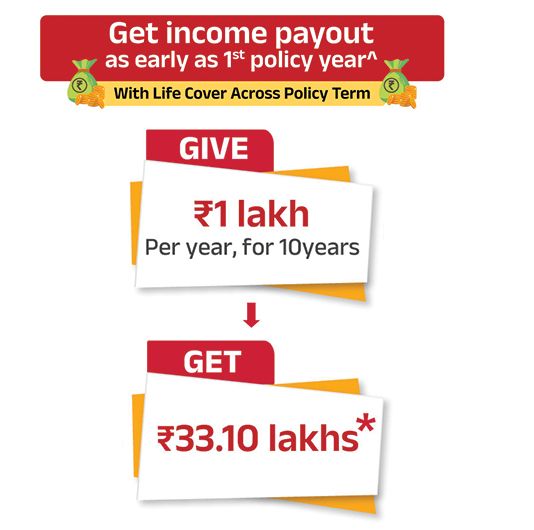
₹33.74 lakhs~

Pay: ₹10K/month for 10 years

This article is for general informational and educational purposes only. It does not constitute financial, investment, legal or tax advice, an invitation to buy, or a product recommendation. Life insurance is a long-term contract. Product features, eligibility, premiums, benefits, exclusions, surrender values and other terms are governed by the applicable policy document and sales prospectus.

*Guaranteed benefits, where applicable, are subject to the policy terms and provided all due premiums are paid. T&C apply. Non-guaranteed benefits, if any, are not assured and may vary according to the terms of the policy.

Tax benefits are subject to prevailing tax laws, eligibility conditions and the tax regime selected. Tax laws are subject to amendments from time to time. Please consult an independent tax adviser for guidance relevant to your circumstances.

whatsapp-imagewhatsapp-image