Aditya Birla Sun Life Insurance Company Limited

Are Guaranteed Income Life Insurance Plans worth it?

Icon-Calender September 4, 2026
Icon-Clock5 min read
★
4.5
Rated by 1000 readers
https://lifeinsurance.adityabirlacapital.comnullCLOSE-BUTTON

Plan Smarter, Live Better!

*Min 3 characters allowed
+91
*Please enter a valid 10 digit Mobile No
https://lifeinsurance.adityabirlacapital.comnullCLOSE-BUTTON
ICON-TICK

Thank you for your details. We will reach out to you shortly.

https://lifeinsurance.adityabirlacapital.comnullCLOSE-BUTTON
ICON-TICK

Currently we are facing some issue. Please try after sometime.

banner-imagemob-image
  • Icon-Index
    Table of Contents

A Guaranteed Income Life Insurance Plan can be worth considering when you need predictable future cash flows, can commit premiums for the full payment term, and value life cover. It may be a poor fit if you need easy access to money, expect the payout to fully offset inflation, or have not yet arranged adequate pure protection.

The right test is not simply “Is the payout guaranteed?” It is whether the policy’s timing, total outgo, effective return, life cover, liquidity conditions, and tax treatment match your goal. “Guaranteed” benefits are payable only as stated in the policy, provided all due premiums are paid and other policy terms and conditions are met.*

## What is a Guaranteed Income Life Insurance Plan?

It is generally a Non-Linked Life Insurance Savings product that combines life cover with predetermined benefits. Depending on the product and option chosen, benefits may include regular income, a maturity amount, or both. The schedule is fixed at inception and is not linked to stock-market performance. The premium-payment term, policy term, deferment period, payout frequency, and income period can differ across products.

Some options begin income during the policy term. Others begin after premiums are paid or after a waiting period. Always use the personalised benefit illustration rather than a headline example to understand your own cash flows.

## What does “guaranteed” actually cover?

The guarantee applies only to benefits expressly identified as guaranteed in the policy schedule or sales brochure. It does not mean that every illustrated amount is unconditional, that the policy can never lapse, or that an early exit will return all premiums paid. T&C apply, and all due premiums must be paid.*

Check whether each amount is a guaranteed income benefit, guaranteed addition, maturity benefit, death benefit, or non-guaranteed element. Also check the start date, frequency, and duration of payments. If the wording is unclear, ask the insurer for a written explanation before signing the proposal form.

## When can such a plan be worth considering?

It may suit a person with a clearly dated goal, stable cash flow, and a preference for predictable benefits over market-linked outcomes. The policy should remain affordable after allowing for emergency savings, health cover, debt repayments, and adequate life protection.

  • You want a defined cash-flow schedule for a future goal such as supplementary retirement income or education expenses.
  • You can hold the policy for its intended term without relying on early surrender.
  • You prefer certainty of stated benefits and understand that certainty may limit growth potential.
  • The death benefit fits into a broader protection plan rather than being assumed to replace need-based term cover.
  • You have read the benefit illustration, exclusions, surrender provisions, and policy servicing rules.

When may it not be the right fit?

It may not fit if your income is uncertain, you may need the money at short notice, or your priority is to maximise life cover for a limited budget. It also needs careful scrutiny when a long payout schedule could lose purchasing power because of inflation.

  • Premiums would strain monthly cash flow or reduce your emergency fund.
  • You may discontinue within the early policy years. Surrender values and paid-up benefits can be materially lower than expected and are governed by the policy terms.
  • You are comparing only the total payout, without considering when each payment arrives.
  • The income remains level for many years and may not keep pace with rising living costs.
  • You need high life cover but the savings plan’s death benefit leaves a protection gap.
## How should you calculate whether the plan is worth it?

List every premium outflow and every expected inflow on its actual date, then calculate the annualised effective return, or internal rate of return. Review the guaranteed cash flows separately from any non-guaranteed illustration. Finally, test whether the real purchasing power remains adequate after inflation.

Do not divide total benefits by total premiums. That ignores the time value of money. Ask for the personalised benefit illustration and compare scenarios using the same assumptions, tenure, and tax basis. If you cannot reproduce the cash-flow calculation, seek help from a qualified financial or tax professional.

## What policy details deserve the closest attention?

Focus on the payment commitment and exit conditions before focusing on the headline income. The most important items are premium term, policy term, deferment period, payout schedule, death benefit, surrender value, paid-up rules, exclusions, Loan conditions, nomination, and claim documentation.

  • Premium obligation: Amount, due dates, grace period, and consequences of non-payment.
  • Income schedule: Start date, payment frequency, duration, and whether the amount is level or increasing.
  • Early exit: Guaranteed and special surrender value rules, if applicable.
  • Protection: Death-benefit formula, exclusions, and whether separate Term Insurance is needed.
  • Optional features: Riders and Policy Loans are product-dependent, may involve extra cost or interest, and should not be treated as universal benefits.
  • Free look: Review the issued policy promptly. Current policyholder-protection rules provide a 30-day free-look period, subject to the applicable terms and permitted deductions.
## How should inflation affect the decision?

A fixed rupee payout can buy less over a long period. A plan should not be described as “inflation beating” unless its contractual benefits and a documented calculation support that claim. Even an increasing-income option needs to be tested against your expected future expenses. Estimate the cost of your target in the year the income begins. Then check the payout again midway through the income period. This simple stress test shows whether the plan is likely to fund the full goal or only provide supplementary income.

## How do tax rules affect guaranteed income plans?

Premium deductions and tax treatment of policy proceeds depend on the prevailing income-tax law, issue date, premium thresholds, life-cover conditions, and the taxpayer’s circumstances. A plan should not be selected solely for a tax benefit, and “tax-free income” should never be assumed without checking eligibility.

Tax laws can change. Obtain advice from a tax professional for your case and retain the policy schedule, premium receipts, and benefit records. The policy’s commercial suitability should still stand even after allowing for a less favourable tax outcome.

## How can ABSLI help you evaluate one option?

Aditya Birla Sun Life Insurance Company Limited offers ABSLI Nishchit Aayush, a Non-Linked, Non-Participating Individual Savings Life Insurance Plan (UIN 109N137V13). Its available benefits and options are governed by the product brochure and policy contract. Before applying, request a personalised benefit illustration and confirm which cash flows are guaranteed*, the premium-payment commitment, surrender provisions, death benefit, and any option-specific conditions.

Product availability, UIN, and terms should be reverified on the official page at the time of purchase. This section is factual product context, not a recommendation.

## So, are Guaranteed Income Life Insurance Plans worth it?

They can be worth considering for predictable, long-term cash flows when affordability, protection, and holding period align. They are not automatically suitable simply because a benefit is guaranteed. The decision should pass five checks: goal fit, full-term affordability, adequate life cover, acceptable liquidity, and a satisfactory effective-return calculation.

Treat the policy as a long-duration contract. Read the sales prospectus, benefit illustration and policy wording, disclose information accurately in the proposal form, and keep copies of all documents. If one of the five checks fails, pause and reassess before committing.

How Much Helpful You Found This Article?

Rating_Star
Rated by 0 reader
/ 5 ( 0 reviews )
Not helpful
Somewhat helpfull
Helpful
Good
Best
RatingTick

Thank you for your feeback

Don’t forgot to share helpful information in your circle

Frequently asked questions

Usually not. The result depends on the product’s lapse, revival, reduced paid-up, and surrender provisions. Full guaranteed benefits generally require all due premiums to be paid. Check the policy document for the amount, if any, payable after discontinuance.*

Not necessarily. Estimate the protection required for income replacement, debts, and major family goals, then compare that need with the policy’s death benefit. A separate Term Insurance Plan may be needed to close a protection gap.

No blanket answer applies. Tax treatment depends on the law in force, policy issue date, premium and cover conditions, aggregate premium thresholds, and your circumstances. Consult a tax professional before relying on an exemption.

Only if the specific policy allows it and the required value has been acquired. Loan availability, limits, interest, and the effect of unpaid Loan balances on benefits are governed by the policy terms.

Compare the full dated cash-flow schedule, effective annualised return, death benefit, premium commitment, payout pattern, surrender and paid-up rules, Loan terms, exclusions, free-look conditions, and how the income may hold up against inflation.

Show All
Hide

Thanks for reaching out. We will reach out to you shortly.

Thanks for reaching out. Currently we are facing some issue.

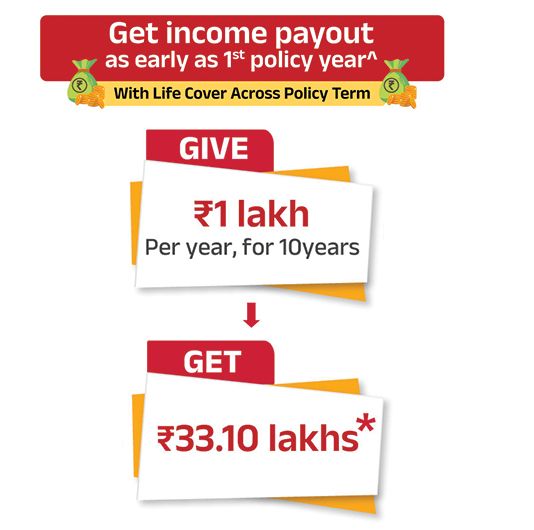
Get immediate income payout after 1 day of policy issuance^

*Min 3 characters
+91phone-icon
*Please enter a valid 10 digit Mobile No.
*This field is required.

ABSLI Nishchit Aayush Plan

ICON-CLICK

Guaranteed# income

ICON-CLICK

Life Cover across policy term

ICON-CLICK

Lumpsum Benefit at policy maturity, in addition to Income

Get :
₹33.74 lakhs~

Pay: ₹10K/month for 10 years

*Guaranteed benefits are payable provided all due premiums are paid and all policy terms and conditions are met. T&C apply.

Tax benefits are subject to provisions of the applicable tax laws, as amended from time to time. Eligibility and tax treatment depend on individual circumstances. Please consult a tax professional for advice.

ABSLI Nishchit Aayush is a non-linked, non-participating individual savings life insurance plan. UIN: 109N137V13.

For more details on risk factors, terms and conditions, please read the sales prospectus carefully before concluding the sale.

Trade Logo “Aditya Birla Capital” displayed above is owned by ADITYA BIRLA MANAGEMENT CORPORATION PRIVATE LIMITED (Trademark Owner) and used by ADITYA BIRLA SUN LIFE INSURANCE COMPANY LIMITED (ABSLI) under licence.

Aditya Birla Sun Life Insurance Company Limited. Registered with Insurance Regulatory and Development Authority of India (IRDAI) as a Life Insurance Company. Registration No. 109. CIN: U99999MH2000PLC128110. Registered Office: One World Center, Tower 1, 16th Floor, Jupiter Mill Compound, 841, Senapati Bapat Marg, Elphinstone Road, Mumbai 400013. Toll-free: 1800-270-7000. Website: https://lifeinsurance.adityabirlacapital.com/

BEWARE OF SPURIOUS PHONE CALLS AND FICTITIOUS / FRAUDULENT OFFERS: IRDAI or its officials do not involve themselves in activities such as selling insurance policies, announcing bonuses or investing premiums. Members of the public receiving such phone calls are requested to lodge a police complaint.

whatsapp-imagewhatsapp-image