Aditya Birla Sun Life Insurance Company Limited

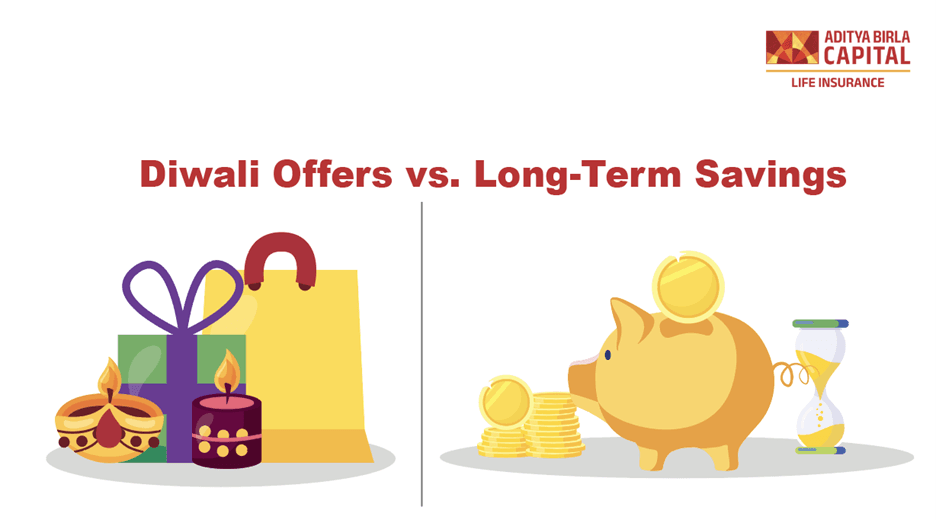
Diwali spending or long-term savings: How can you balance both in 2026?

Icon_Calender September 4, 2026
Icon-Clock5 mins read
★
4.5
Rated by 1000 readers
https://lifeinsurance.adityabirlacapital.comnullCLOSE-BUTTON

Plan Smarter, Live Better!

*Min 3 characters allowed
+91
*Please enter a valid 10 digit Mobile No
https://lifeinsurance.adityabirlacapital.comnullCLOSE-BUTTON
ICON-TICK

Thank you for your details. We will reach out to you shortly.

https://lifeinsurance.adityabirlacapital.comnullCLOSE-BUTTON
ICON-TICK

Currently we are facing some issue. Please try after sometime.

banner-imagemob-image
  • Icon-Index
    Table of Contents

You do not have to choose between enjoying Diwali and saving for the future. A practical approach is to decide what you can spend without borrowing, protect money needed for near-term expenses, and commit only an affordable amount to long-term goals. The right balance depends on your cash flow, responsibilities, and time horizon.

For many households, festive spending is emotional as well as financial. Gifts, travel, home purchases, and celebrations matter. The problem begins when a limited-period offer changes a planned purchase into an unplanned liability, or when a long-term saving commitment is made without checking whether future premiums will remain affordable.

What is the real difference between a Diwali offer and long-term saving?

A Diwali offer changes the price or terms of a purchase you make today. Long-term saving directs money towards a future goal. Neither is automatically right or wrong. The useful question is whether the decision serves a planned need without weakening your emergency buffer or other financial commitments.

A discount creates value only when you have already intended to buy the item, compare the final price, and can pay without expensive borrowing. Buying something unnecessary does not become saving simply because its listed price is reduced. Equally, setting money aside is useful only when the method matches the goal, risk, access needs, and holding period.

Decision

Useful when

Warning sign

Use a festive offer

The purchase is planned, the final price is competitive, and payment fits your budget.

You are buying mainly because a countdown, coupon, or ‘limited stock’ message creates urgency.

Keep money liquid

The money may be needed for bills, emergencies, or a goal due soon.

You lock away funds that may be required before the commitment ends.

Save for a long-term goal

The goal is several years away and regular contributions are affordable.

You choose a long contract before reading benefits, exclusions, and exit conditions.

How can you make a festive budget before opening shopping apps?

Start with a rupee limit, not a discount percentage. Calculate the amount left after regular bills, existing premiums or instalments, near-term commitments, and an emergency reserve. That remaining amount is the ceiling for celebration and optional purchases, not a target that must be spent. Use three simple buckets: planned celebration, short-term safety, and long-term goals. Do not force a standard ratio onto every household.

Someone with variable income or a thin emergency reserve may need a larger safety bucket. Someone with stable cash flow and a fully funded near-term buffer may be able to direct more towards a distant goal.

  • List gifts, travel, food, clothing, and home expenses before browsing offers.
  • Set one total limit and a smaller limit for each category.
  • Compare the final payable amount, including fees, delivery, and financing costs.
  • Use a cooling-off pause for any purchase that was not on the list.
  • Move the amount earmarked for goals before discretionary shopping begins.

Should you use a Diwali bonus for spending, debt, or savings?

A bonus can do several jobs, so rank them by consequence. First cover overdue essentials and high-cost obligations. Next strengthen accessible emergency money if it is inadequate. Then fund planned festive expenses. Only the amount that remains, and will not be needed soon, should be considered for a long-term commitment.

This order is a planning framework, not personal financial advice. Your priorities may differ if you have unstable income, upcoming medical or education costs, or dependants who rely on you. The central test is resilience: will this allocation leave you able to manage an unexpected expense without breaking a long-term contract or taking costly credit?

When does long-term saving make sense?

Long-term saving makes sense when the goal has a clear amount and date, the contribution is affordable across ordinary months, and the chosen option matches the need for access and certainty. Examples of goals may include education, retirement, a future home contribution, or creating a predictable financial reserve.

For more planning detail, see How to plan your savings and How does the power of compounding work?.

Where can a Life Insurance Savings Plan fit?

A Savings Life Insurance Policy may combine life cover with defined maturity or income benefits, subject to the policy terms. It can suit a person who needs both protection and disciplined, long-term contributions. It is not a replacement for accessible emergency money, and it should not be selected only because a festive campaign creates urgency. Before buying, separate guaranteed benefits from non-guaranteed benefits in the authorised benefit illustration.

Check the policy term, premium-paying term, death benefit, maturity benefit, exclusions, surrender provisions, Loan provisions if any, and the effect of missing premiums. Confirm that the premium remains manageable alongside existing protection and goals.

Aditya Birla Sun Life Insurance offers Savings Life Insurance Plans with features that vary by policy. Review the applicable sales brochure, benefit illustration and policy wording before deciding. Product suitability depends on your needs, affordability, and risk profile.

What should you check before making a Long-Term Insurance commitment?

Treat the policy documents as the decision source, not the campaign headline. Under India’s current policyholder-protection framework, clear pre-sale information, and post-sale servicing matter. Ask questions until you understand what is payable, when benefits arise, and what happens if circumstances change.

  • Need: What financial risk and goal is the policy meant to address?
  • Affordability: Can you pay every due premium without depending on an uncertain bonus?
  • Benefit status: Which amounts are guaranteed, provided all due premiums are paid, and which are non-guaranteed?
  • Exit: What surrender value or other consequence may apply if you stop early?
  • Disclosure: Have you answered health, occupation, income, and lifestyle questions completely and accurately?
  • Documentation: Does the benefit illustration match what was explained to you?
  • Review: Read the issued policy promptly and use the applicable free-look provisions if it does not match your understanding, subject to policy terms and regulatory rules.

Also read: What should you know before choosing an Endowment Plan in 2026?

How can you avoid impulse buying during festive sales?

Reduce the speed of the decision. Remove saved card details, switch off promotional notifications, and keep a written purchase list. For an unplanned item, ask whether you would buy it at the same final price without a sale label. If the answer is no, the offer may be driving the need.

What is a practical Diwali money routine?

Use Diwali as an annual review cue rather than a deadline to buy. One week before planned shopping, set the budget, and list. When income or a bonus arrives, allocate it by priority. After the festival, record actual spending, and redirect any surplus to the relevant goal. Repeat the review each year.

Conclusion

Diwali offers and long-term savings serve different purposes. Plan the celebration, protect liquidity, and direct only affordable surplus towards future goals. If a Life Insurance Savings Policy is being considered, judge it by your need and its verified policy terms, not by urgency, slogans, or an assumed return.

How Much Helpful You Found This Article?

Rating_Star
Rated by 0 reader
/ 5 ( 0 reviews )
Not helpful
Somewhat helpfull
Helpful
Good
Best
RatingTick

Thank you for your feeback

Don’t forgot to share helpful information in your circle

Frequently asked questions

Only when the purchase was already planned, the final price is genuinely lower after all charges, and paying for it does not disrupt essential expenses or goals. Spending less than a displayed price is not the same as building savings. If the item is unnecessary, not buying it may leave more money available for another priority.

There is no universal percentage. Decide after accounting for essential expenses, near-term obligations, emergency liquidity, and planned celebrations. Choose an amount that supports a defined goal and remains realistic. If future premiums are involved, assess affordability using regular income rather than assuming that every year’s bonus will be available.

Buy only if the policy meets an identified protection and savings need, the premium is affordable and you understand the full term. A seasonal offer should not determine suitability. Read the authorised sales prospectus, benefit illustration, and policy wording, and check guaranteed and non-guaranteed benefits, exclusions, and surrender conditions.

They should generally not be your only emergency resource. A long-term product may have access restrictions or an early-exit impact. Emergency money should be kept in a suitably accessible form. Build that buffer before locking away money that may be needed for urgent household, health or income-related expenses.

Do not stretch the budget to begin one. Review lower, sustainable contributions, and other suitable ways to address the goal. If you already hold a policy, consult its terms, or contact the insurer before stopping premiums because paid-up, lapse, revival, or surrender consequences vary by product and timing.

Show All
Hide

References

  • Department of Financial Services, Government of India. IRDAI (Protection of Policyholders’ Interests, Operations and Allied Matters of Insurers) Regulations, 2024. https://financialservices.gov.in/act-and-policies/3485
  • Master Circular on Protection of Policyholders’ Interests, 2024, dated 5 September 2024. Verify the currently operative version before publication.
  • Aditya Birla Sun Life Insurance. Live source article and company disclosures. https://lifeinsurance.adityabirlacapital.com/articles/savings-insurance/diwali-offers-vs-long-term-savings/

Thanks for reaching out. We will reach out to you shortly.

Thanks for reaching out. Currently we are facing some issue.

Get immediate income payout after 1 day of policy issuance^

*Min 3 characters
+91phone-icon
*Please enter a valid 10 digit Mobile No.
*This field is required.

ABSLI Nishchit Aayush Plan

ICON-CLICK

Guaranteed# income

ICON-CLICK

Life Cover across policy term

ICON-CLICK

Lumpsum Benefit at policy maturity, in addition to Income

Get :
₹33.74 lakhs~

Pay: ₹10K/month for 10 years

This article is intended only for general information and financial education. It does not constitute financial, investment, tax or legal advice, or a recommendation to purchase any insurance product. Policy benefits, exclusions, limitations, premiums, surrender values and other terms vary by product. Please read the applicable sales brochure, benefit illustration and policy document carefully before concluding the sale.

For more details on risk factors, terms and conditions please read sales prospectus carefully before concluding the sale.

Aditya Birla Sun Life Insurance Company Limited, Registered with Insurance Regulatory & Development Authority of India (IRDAI) as Life Insurance Company. Registered Office: One World Center Tower 1, 16th Floor, Jupiter Mill Compound, 841, Senapati Bapat Marg, Elphinstone Road, Mumbai - 400013. Toll free no. 1800-270-7000. https://lifeinsurance.adityabirlacapital.com/ | care.lifeinsurance@adityabirlacapital.com | CIN: U99999MH2000PLC128110 | Registration No. 109.

Trade Logo ‘Aditya Birla Capital’ displayed above is owned by ADITYA BIRLA MANAGEMENT CORPORATION PRIVATE LIMITED (Trademark Owner) and used by ADITYA BIRLA SUN LIFE INSURANCE COMPANY LIMITED (ABSLI) under the license.

BEWARE OF SPURIOUS PHONE CALLS AND FICTITIOUS / FRAUDULENT OFFERS: IRDAI or its officials do not involve in activities like selling insurance policies, announcing bonus or investment of premiums. Public receiving such phone calls are requested to lodge a police complaint.

whatsapp-imagewhatsapp-image