Aditya Birla Sun Life Insurance Company Limited

How can you grow your savings without giving up everyday joy?

Icon-Calender September 4, 2026
Icon-Clock5 min read
★
4.5
Rated by 1000 readers
https://lifeinsurance.adityabirlacapital.comnullCLOSE-BUTTON

Plan Smarter, Live Better!

*Min 3 characters allowed
+91
*Please enter a valid 10 digit Mobile No
https://lifeinsurance.adityabirlacapital.comnullCLOSE-BUTTON
ICON-TICK

Thank you for your details. We will reach out to you shortly.

https://lifeinsurance.adityabirlacapital.comnullCLOSE-BUTTON
ICON-TICK

Currently we are facing some issue. Please try after sometime.

banner-imagemob-image
  • Icon-Index
    Table of Contents

You can grow your savings without cutting out every pleasure by giving each rupee a job: cover essentials, build an accessible emergency buffer, save automatically for named goals, protect major financial risks, and keep a planned amount for guilt-free spending. The method matters more than a short burst of extreme cost-cutting.

In 2026, the most useful Savings Plan is still one you can repeat. Start with your actual cash flow, separate near-term money from long-term goals and review the system when your income or responsibilities change. The following eight approaches turn a broad intention to “save more” into practical decisions:

How can a flexible budget help you save consistently?

A flexible budget shows what is available after essentials and commitments, then assigns a realistic amount to savings and discretionary spending. It is not a punishment sheet. It is a decision tool that helps you notice patterns, prepare for irregular costs, and avoid saving an amount you will need to withdraw immediately.

Begin with recent account and card statements. Group spending into essentials, financial commitments, goals, and wants. Add non-monthly costs such as annual renewals, repairs, school expenses, or festivals to a “future bills” bucket. RBI financial-education material recommends budgeting and planning expenditure as part of sound money management.

Set a savings amount that can survive an ordinary month. If income varies, use a modest baseline and add a proportion of higher-income months. Review the budget after a few cycles. A plan that bends is more useful than one abandoned after a single overspend.

Why should every savings goal have a name and date?

A named goal makes the amount, timing, and priority easier to judge. “Save for travel next summer” gives you more direction than “save more”. It also helps you avoid using long-term money for a near-term expense or taking unsuitable risk with money you may need soon. Write down the goal, expected cost, target date, and amount already available. Divide the remaining amount across the time left, while allowing for reasonable changes in cost.

Goals can then be ranked as essential, important or optional. Emergency reserves and unavoidable commitments generally need attention before lifestyle goals. Keep goals separate in your records or through labelled account buckets if your provider offers them. The separation is behavioural, not magical. It helps you see whether each goal is on track and makes an unplanned withdrawal a conscious choice.

How does automating savings reduce reliance on willpower?

Automation moves money according to a rule you set, so saving does not depend on remembering at the end of the month. Schedule the transfer soon after income arrives but leave enough in the transaction account for essential payments, and routine variability. Start at a comfortable level. A transfer that repeatedly causes a shortfall can lead to reversals, fees or debt, which defeats the purpose.

Check the first few transfers, then review the amount whenever income, rent, debt payments or family responsibilities change. Automation should not mean neglect. Confirm where the money goes, how quickly it can be accessed, and whether any charges or conditions apply. Keep payment alerts active and never approve an instruction you do not understand.

Why is an accessible emergency buffer important?

An emergency buffer protects goal-based savings from sudden, necessary expenses. Keep it separate from day-to-day spending, and in a place that is easy to access. RBI financial-education guidance specifically recommends maintaining emergency money in a separate, accessible Savings Account. Choose the target from your own essential expenses, income stability, dependents, Insurance coverage, and health needs.

There is no universal amount that suits every household. Build it in stages and define what counts as an emergency, such as essential repair, urgent travel, or temporary loss of income. After using the funds, add rebuilding to the budget. Do not chase higher potential returns with money whose main job is immediate availability and stability.

How can you choose a suitable place for each savings bucket?

Match the option to the goal rather than choosing on a headline return alone. Consider when the money is needed, how certain that date is, ease of withdrawal, risk of loss, charges, tax treatment, and your ability to understand the terms. Money for near-term or uncertain needs usually requires ready access.

Longer-term goals may allow a different balance of access and risk, but potential returns are not assured unless the terms explicitly say so and all applicable conditions are met. Read official documents, not only promotional summaries. Avoid making a decision because of social-media excitement, pressure or an unfamiliar link.

Verify the regulated entity, understand how complaints are handled, and keep copies of applications, statements, and communications. When in doubt, pause, and seek qualified help.

Where do Insurance and protection fit into a Savings Plan?

Insurance supports a savings plan by transferring specified financial risks. It is not a substitute for an emergency fund or a universal route to wealth creation. Life cover can help protect dependents if the insured person dies, while other Insurance addresses different covered risks subject to policy terms and exclusions.

First identify the risk, the people financially dependent on you, existing cover, and the premium you can sustain. If considering a Life Insurance Savings Plan, distinguish the protection element from any maturity or income benefit. Review the benefit illustration, premium-payment term, surrender provisions, exclusions, and policy wording before deciding.

Aditya Birla Sun Life Insurance Company Limited offers Life Insurance options across protection and savings needs. A plan should be considered only after assessing suitability, affordability, and the applicable product terms. Read the sales prospectus and policy document carefully before concluding the sale.

How can tax awareness improve a savings decision?

Tax treatment can affect the final outcome, but it should follow suitability, not replace it. Check which tax regime applies to you, whether a deduction or exemption is actually available and whether conditions or limits affect eligibility. The Income Tax Department explains that deductions available under the new and old tax regimes differ.

Tax laws and individual circumstances can change, so do not rely on an old article, forwarded message, or a generic calculator as personal tax advice. Keep relevant records and consult a tax professional where necessary. A weak product does not become suitable merely because a tax provision may apply. Compare the decision with your goal, access needs, protection requirement, costs, and ability to continue payments.

When should you review the plan or seek professional help?

Review your savings system after a meaningful life or income change and at a regular interval you can maintain. Check whether goals, target dates, emergency access, nominations, Insurance cover, and automatic transfers still reflect your circumstances. Seek a qualified financial professional if the choices are complex, the consequences are significant or you do not understand the risks and terms.

Ask how the adviser is regulated, compensated, and expected to act. Request written explanations and take time to read them. Start with one small action today. Label a savings goal, schedule a manageable transfer, or list essential expenses for an emergency target. Progress should be deliberate, affordable, and reviewable, not driven by fear or pressure.

What should you remember before acting?

Growing savings is a system, not a single product choice. A useful system combines a workable budget, named goals, automation, accessible emergency money, suitable financial tools, protection against major risks, tax awareness, and periodic review. Keep enjoyment in the plan by budgeting for it. That makes the habit easier to sustain without weakening essential priorities.

How Much Helpful You Found This Article?

Rating_Star
Rated by 0 reader
/ 5 ( 0 reviews )
Not helpful
Somewhat helpfull
Helpful
Good
Best
RatingTick

Thank you for your feeback

Don’t forgot to share helpful information in your circle

Frequently asked questions

Keep enough accessible money for urgent needs while prioritising costly or overdue debt. The balance depends on interest, penalties, income stability, and household risk. Avoid emptying all emergency savings without considering how a new unexpected expense would be funded.

Automation can be useful when you verify the destination, maintain sufficient balance, activate alerts, and review the instructions. Use official channels, protect authentication details, and cancel or change transfers that no longer fit your cash flow.

Some Life Insurance Plans combine life cover with specified maturity or income benefits, subject to policy terms. Assess the protection need, benefit illustration, premium commitment, access limitations, surrender provisions, and exclusions. Insurance should not replace accessible emergency savings.

Change it when income, essential expenses, dependents, debt, or the goal itself changes. A regular review is useful, but avoid frequent reactions to noise. Update the target using current costs and the time left, then confirm the contribution remains affordable.

Show All
Hide

References

[1] Reserve Bank of India, “Financial Planning”, financial-education material: https://rbi.org.in/FinancialEducation/content/I%20Can%20Do_RBI.pdf (accessed 2 September 2026).

[2] Income Tax Department, Government of India, “Salaried Individuals for AY 2026-27”: https://www.incometax.gov.in/iec/foportal/help/individual/return-applicable-1 (accessed 2 September 2026).

[3] Insurance Regulatory and Development Authority of India, official website and policyholder resources: https://irdai.gov.in/ (accessed 2 September 2026).

[4] Aditya Birla Sun Life Insurance Company Limited, live source article, “8 Interesting Ways To Make Your Savings Grow”, dated 13 January 2023: https://lifeinsurance.adityabirlacapital.com/articles/savings-insurance/8-interesting-ways-to-make-your-savings-grow/ (accessed 2 September 2026).

Thanks for reaching out. We will reach out to you shortly.

Thanks for reaching out. Currently we are facing some issue.

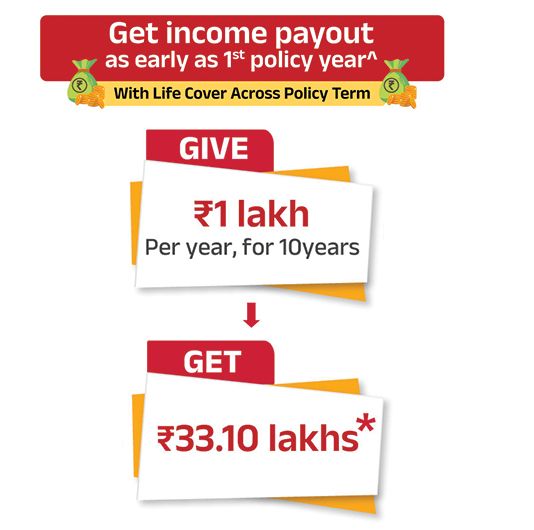
Get immediate income payout after 1 day of policy issuance^

*Min 3 characters
+91phone-icon
*Please enter a valid 10 digit Mobile No.
*This field is required.

ABSLI Nishchit Aayush Plan

ICON-CLICK

Guaranteed# income

ICON-CLICK

Life Cover across policy term

ICON-CLICK

Lumpsum Benefit at policy maturity, in addition to Income

Get :
₹33.74 lakhs~

Pay: ₹10K/month for 10 years

This article is for general information and financial education only. It does not constitute investment, insurance, legal or tax advice, and it does not recommend any product. Insurance is the subject matter of solicitation. Product availability, benefits, premiums, exclusions and other terms are governed by the applicable sales literature and policy contract.

Tax benefits are subject to provisions of the Income-tax Act, 1961, as amended from time to time, and to the individual’s tax regime and circumstances. Please consult an independent tax adviser for personalised guidance.

For more details on risk factors, terms and conditions, please read the sales brochure carefully before concluding the sale.

Aditya Birla Sun Life Insurance Company Limited, registered with the Insurance Regulatory and Development Authority of India as a life insurance company. Registration No. 109. CIN: U99999MH2000PLC128110. Registered Office: One World Center, Tower 1, 16th Floor, Jupiter Mill Compound, 841 Senapati Bapat Marg, Elphinstone Road, Mumbai 400013. Toll-free: 1800-270-7000. Website: https://lifeinsurance.adityabirlacapital.com/

Trade Logo “Aditya Birla Capital” is owned by Aditya Birla Management Corporation Private Limited and used by Aditya Birla Sun Life Insurance Company Limited under licence.

BEWARE OF SPURIOUS PHONE CALLS AND FICTITIOUS OR FRAUDULENT OFFERS. IRDAI or its officials do not involve themselves in activities such as selling insurance policies, announcing bonus or investment of premiums. Members of the public receiving such phone calls are requested to lodge a police complaint.

whatsapp-imagewhatsapp-image