An Endowment Plan and a Fixed Deposit (FD) solve different problems even though both feel "safe." Aditya Birla Sun Life Insurance (ABSLI), an IRDAI-registered life insurer, structures Endowment Plans to combine a life cover with disciplined savings, while a Bank FD is a pure, time-bound savings instrument with no life cover attached. If your goal is only to park a lump sum for a fixed period, an FD is simpler.
If you also need your family financially protected while you save, an Endowment Plan does both jobs in one product. The rest of this comparison walks through returns, safety, liquidity, and tax, so you can match the choice to your actual goal rather than to whichever sounds safer on the surface.
What is an Endowment Plan?
An Endowment Plan is a Life Insurance Policy that pays a maturity benefit if you survive the policy term, and a death benefit to your nominee if you do not. Every premium you pay builds two things at once: a savings component that grows into the maturity payout, and a life cover that protects your family through the policy term. This dual structure is what separates it from a pure savings product like an FD, where there is no Insurance element at all.
Because the cover runs for the full term, an Endowment Plan works best as a long-horizon goal (retirement corpus, a child's education fund, or a legacy amount) rather than as a place to park money for a year or two.
What is a Fixed Deposit?
A Fixed Deposit is a lumpsum deposit placed with a bank, small finance bank, or NBFC for a chosen tenure, at an interest rate fixed at the time of booking. The bank pays you back the principal plus interest at maturity, or at your chosen payout frequency. FDs are regulated by the RBI, and deposits with a bank are insured up to ₹5 lakh per depositor per bank (principal plus interest combined) under the DICGC scheme.
There is no life cover bundled in. If the depositor passes away during the tenure, the deposit simply passes to the nominee or legal heir, same as any other bank balance.
Endowment Plans vs. Fixed Deposits: Returns compared
FD returns are fixed and known upfront. The bank quotes a rate at booking, and that is what you earn, regardless of how markets move. Endowment Plan returns are structured differently. A guaranteed portion is fixed at policy issuance, and many plans add non-guaranteed bonuses declared by the insurer depending on its performance, so the final maturity amount can exceed the guaranteed base but is not entirely fixed like an FD. Neither product carries market-linked risk the way a ULIP or Mutual Fund does, but "safe" does not mean "identical".
An FD's rate is locked and transparent from day one, while an Endowment Plan's total return depends partly on bonus additions declared over the term. Always check the specific plan's benefit illustration for the guaranteed and non-guaranteed components before comparing numbers.
Which is safer: Endowment Plans or FDs?
Both are considered low-risk, but the safety comes from different guarantors. A Bank FD is protected up to ₹5 lakh per depositor per bank (principal plus interest) by the DICGC, a wholly owned subsidiary of the RBI. Any amount beyond ₹5 lakh in that bank is not insured. An Endowment Plan's safety comes from IRDAI's regulation of the insurer and from the policy contract itself, since the sum assured and guaranteed benefits are contractual obligations of the insurer, not deposit-insurance-limited.
Neither is "safer" in absolute terms. They are safe against different kinds of risk (bank failure vs. insurer solvency), which is why diversifying across both, rather than picking one exclusively, is common practice for conservative savers.
How do liquidity and premature withdrawals work between the two?
An FD is the more liquid of the two. Most banks allow premature closure, though this usually comes with a penalty, typically a reduction in the interest rate actually paid. An Endowment Plan is designed to be held for the full term. Exiting early usually means surrendering the policy for a surrender value, which in the early years can be significantly lower than the premiums paid, since a large part of early premiums goes toward the cost of life cover and policy charges.
If there is a real chance you will need the money back within a year or two, an FD's exit terms are simpler and less costly than surrendering an Endowment Plan early.
What are the tax treatments? Endowment Plans vs. Fixed Deposits
This is where the two diverge the most.
FD interest: Fully taxable, added to your income, and taxed at your slab rate, under "Income from Other Sources." Banks deduct TDS at 10% if your total FD interest in a year exceeds ₹50,000 (₹1,00,000 for senior citizens). It rises to 20% without a valid PAN on file. TDS is not the final tax. You still report and pay tax on the full interest at your slab rate while filing returns.
Endowment Plan premiums: Can qualify for a deduction of up to ₹1.5 lakh a year under Section 80C (now Section 123, read with Schedule XV, under the Income-tax Act, 2025), but only if you file under the old tax regime.
Endowment Plan maturity proceeds: Including bonuses, are exempt under Section 10(10D) (now Section 11, read with Schedule II) if the annual premium does not exceed 10% of the sum assured, and, for Non-ULIP policies issued on or after 1 April 2023, if the aggregate annual premium across such policies does not exceed ₹5 lakh. The death benefit is always fully tax-free, irrespective of premium size.
GST: On Individual Life Insurance Policies, including Endowment Plans, is nil with effect from 22 September 2025, which lowers the effective cost of the cover component compared with earlier years.
Disclaimer: This is general information based on current tax law and is not personalised tax advice. Tax treatment depends on your specific policy structure, premium levels and applicable regime; please verify with a tax advisor or chartered accountant before relying on it for filing.
So, which one to choose?
There is no universal winner. The right pick depends on what you are actually solving for.
- Choose an FD if you need a fixed, transparent return over a defined short-to-medium tenure, want the flexibility to break the deposit if plans change, and do not need life cover attached to this specific saving.
- Choose an Endowment Plan if your time horizon is long (typically 10+ years), you want your family protected in case something happens to you during that period, and you would value the tax treatment on maturity proceeds alongside a savings component.
- A common middle path many households use is to hold both. An FD for near-term liquidity and emergency-adjacent goals, and an Endowment Plan for a long-term goal that also needs a life-cover safety net.






 September 4, 2026
 5 min
5 min


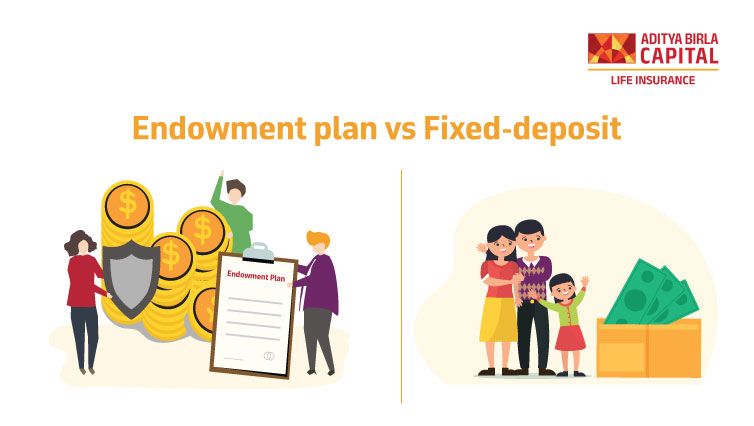
 Table of Contents


 BUY ONLINE