

- All Insurance
- Endowment Plans
- Savings PlansNew
- Term Insurance
- Pension PlansNew
- Critical Illness Insurance
- ULIP Plan
- Group Insurance
- Protection Solutions
- Employer Employee
- Voluntary
- Affinity
- Credit Life
- Retirement Solutions
- Annuity Scheme
- Gratuity
- Leave Encashment
- Post Retirement Medical Benefits Scheme
- Superannuation
- Withdrawn Products
- NRI Plans
- Articles
- Where Do I?
- Find Customer Service
- Learn About Life Insurance
- Become a Life Insurance Advisor
- Know Our Funds
- Manage My Claim
- Know more about UPI Autopay
- Read FAQs
- Register For One ABC Id
- Download Forms
- Read Market Outlook
- Download Public Disclosures
- Disclosure of Key Performance and Financial Parameters
- Financial Calculator
- Know your Advisor
- Term Insurance
- Manage My Policy
- Her Insurance

Connect
Aditya Birla Sun Life Insurance Company Limited



Aditya Birla Sun Life Insurance Company Limited
What are POMIS premature closure rules?
 May 25, 2026
 5 mins read

Plan Smarter, Live Better!


 Table of Contents
How Much Helpful You Found This Article?

Rated by 0 reader
/ 5 ( reviews )
Not helpful
Somewhat helpfull
Helpful
Good
Best

Thank you for your feeback
FAQs
Yes. POMIS can be closed prematurely, but only according to scheme rules. India Post states that the National Savings Monthly Income Account has a 5-year maturity period and permits premature closure only after one year from the date of opening.
No. A POMIS account cannot normally be closed before completion of one year from the date of opening under the standard premature-closure rule.
If you close the account after one year but before three years, premature closure is allowed, but 2% of the principal deposit is deducted. If you close it after three years but before five years, 1% of the principal deposit is deducted.
The penalty is 2% of the deposit amount. The balance principal is returned after this deduction.
The penalty is 1% of the deposit amount. The remaining principal is paid back after this deduction.
No. You do not lose all your money. You receive your principal back after the applicable 1% or 2% deduction, depending on when you close the account.
The official premature-closure clarification refers to a deduction from the deposit amount, which indicates that the penalty is applied to the principal. In normal interpretation, the monthly interest already received is not separately reversed, but the exact payout should still be confirmed with the post office at the time of closure.
If you hold the account for the full 5-year term, there is no premature closure penalty. You receive your full principal back at maturity, and you keep the monthly interest already paid during the tenure.
The current tenure of POMIS is 5 years, according to India Post and the National Savings Institute.
Because POMIS is meant for planned monthly income, not for emergency liquidity. Since the scheme has a one-year lock-in and penalties for early exit, it may not suit money that you might need suddenly. This is a suitability inference based on the official closure rules and scheme structure.
Usually no. Since the account cannot normally be closed within the first year and carries penalties after that, it is generally not ideal for emergency money. This is a practical conclusion based on the official premature-closure rules.
Yes. It can still make sense if you urgently need the money for a medical emergency, debt repayment, or a major change in financial priorities. In such cases, paying the 1% or 2% penalty may be worth it. This is practical financial reasoning based on the official penalty structure.
The current maximum investment is ₹9 lakh in a single account and ₹15 lakh in a joint account.
Not necessarily. POMIS can still be a good monthly income product if you are reasonably sure you can keep the money invested for the planned period. The premature-closure rules simply mean it is better suited for stable, planned money rather than uncertain, highly liquid funds. This is an inference based on the scheme’s income-focused structure and closure penalties.
The simplest way to remember them is:
● Before 1 year: no normal premature closure
● After 1 year but before 3 years: 2% penalty on deposit
● After 3 years but before 5 years: 1% penalty on deposit
● At 5 years: no premature-closure penalty applies
Show All
Hide
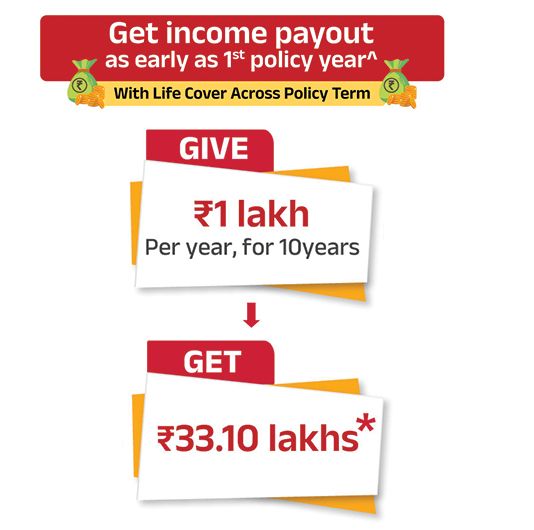
Get immediate income payout after 1 day of policy issuance^
ABSLI Nishchit Aayush Plan

Guaranteed# Income
Life Cover across policy term
Lumpsum Benefit at policy maturity.
Get:
₹39.22 lakhs~
Pay:
₹1 Lakh/year for 12 Years
 BUY ONLINE
Recently Added Article





Most Popular Calculator


This blog is for information and awareness purposes only and does not purport to any financial or investment services and do not offer or form part of any offer or recommendation. The information is not and should not be regarded as investment advice or as a recommendation regarding any particular security or course of action.
Every effort is made to ensure that all information contained in this blog is accurate at the date of publication, however, the Aditya Birla Sun Life shall not have any liability for any damages of any kind (including but not limited to errors and omissions) whatsoever relating to this material.
ADV/5/26-27/205

