Aditya Birla Sun Life Insurance Company Limited

Term Life Insurance for smokers vs. non-smokers: What changes in 2026

Icon-Calender September 9, 2026
Icon-Clock5 mins read
★
4.5
Rated by 1000 readers
https://lifeinsurance.adityabirlacapital.comnullCLOSE-BUTTON

Plan Smarter, Live Better!

*Min 3 characters allowed
+91
*Please enter a valid 10 digit Mobile No
https://lifeinsurance.adityabirlacapital.comnullCLOSE-BUTTON
ICON-TICK

Thank you for your details. We will reach out to you shortly.

https://lifeinsurance.adityabirlacapital.comnullCLOSE-BUTTON
ICON-TICK

Currently we are facing some issue. Please try after sometime.

banner-imagemob-image
  • Icon-Index
    Table of Contents

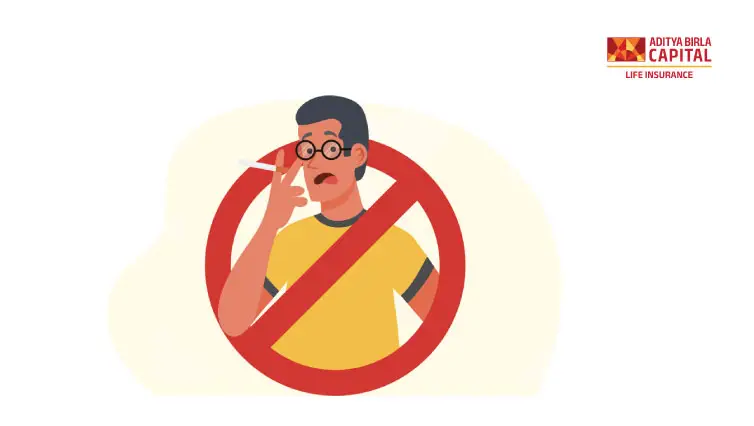
Insurers classify every Term Insurance applicant as either a smoker or a non-smoker, and that single label can change your premium by a wide margin. The classification depends on tobacco or nicotine use within a recent look-back period, not on how often you smoke. Someone who has an occasional cigarette at a social gathering can still be underwritten as a smoker if that use falls inside the insurer's defined window. How insurers decide, verify, and price this in 2026 is covered below.

How do insurers decide whether you are a smoker or a non-smoker?

Insurers treat you as a smoker if you have used any tobacco or nicotine products, including cigarettes, bidis, gutkha, cigars, or nicotine gum, within a defined look-back period, usually the last 12 to 36 months, regardless of how often you use it. This wide definition exists because nicotine's metabolite, cotinine, stays detectable in blood or urine well after use, which is why underwriters commonly rely on a cotinine test alongside the proposal form and medical examination before confirming your rating.

Even a social smoker who lights up only at gatherings will usually be rated as a smoker unless they clear the insurer's specified non-use period. Declaring accurately at this stage, including any nicotine gum or vaping, protects the policy later.

How much do smokers pay for Term Insurance?

Smokers typically pay noticeably higher premiums than non-smokers for the same Term Insurance cover, because tobacco use is statistically linked to a higher likelihood of an early claim. Independent industry comparisons published in 2025 place the smoker loading in the region of 25% to 100% over non-smoker rates for identical Life Insurance cover, with the exact gap depending on the applicant's age and the insurer's underwriting approach. *

For a healthy 30-year-old buying ₹1 crore of cover for 30 years, that gap alone can add a meaningful amount to the monthly premium. Because insurer pricing changes periodically, always confirm the current premium using the Term Plan premium calculator rather than relying on an older quote.

What happens if you hide your smoking habit from the insurer?

Insurers can and often do detect undisclosed smoking during the medical test, a pre-issuance verification call, or a later investigation. A mis-declared habit is treated as a material non-disclosure, which can lead to a rejected proposal, or if it surfaces after a claim, to the policy being repudiated. This follows Section 45 of the Insurance Act, 1938, which allows an insurer to examine a policy within three years of issue on the grounds of a material misstatement, whether or not a claim has been made.

Can you hide occasional smoking when buying Term Insurance?

The most common mistake applicants make is assuming an occasional cigarette does not count. Underwriters do not distinguish between social and regular use. They work from the look-back period alone. Declaring the habit honestly at proposal stage, even if it raises the premium, is what keeps the cover reliable for your family.

Can you get non-smoker rates if you quit smoking?

Yes, but only on a new policy. An existing Term Insurance premium is fixed at the rate agreed when the policy is issued and does not fall automatically once you quit. Insurers reassess smoking status only at the point of a fresh proposal. If you stay tobacco-free for the insurer's specified period, commonly 12 to 36 months, you become eligible to apply afresh at non-smoker rates on a new policy.

Timing matters here. Someone who quit early and waits out the qualifying period before buying cover, rather than buying while still smoking and hoping to revise the premium later, generally pays less over the life of the policy.

Does Return of Premium option make sense for smokers?

A Return of Premium (RoP) Term Plan pays back the premiums you have paid, as a lumpsum assured on maturity, if you survive the policy term, unlike a standard Term Plan that pays nothing on survival. For smokers, whose base premiums are already higher, an RoP variant adds a further loading on top of that higher base rate, since the insurer must also fund the eventual maturity payout.

The trade-off is straightforward: RoP gives you a lumpsum back if you outlive the term, but it costs meaningfully more each month than a pure protection plan with the same life cover. Weigh this against your household's protection needs and premium budget, not against how the option is marketed.

How can smokers choose the right Term Insurance Plan?

Being a smoker does not mean you cannot get Term Insurance. It simply means your premium and eligibility will be assessed based on your disclosed tobacco or nicotine use and the insurer’s underwriting criteria. If you are considering a Term Plan, the ABSLI Super Term Plan is designed for salaried applicants, and it applies to the same smoker/non-smoker underwriting norms described above.

If you are ready to explore your options, you can calculate your premium online and see how your profile affects the cost of term insurance before making a decision.

How Much Helpful You Found This Article?

Rating_Star
Rated by 0 reader
/ 5 ( 0 reviews )
Not helpful
Somewhat helpfull
Helpful
Good
Best
RatingTick

Thank you for your feeback

Don’t forgot to share helpful information in your circle

Frequently asked questions

Yes. Most insurers define smoker status by nicotine or tobacco use in any form, not only cigarettes, so vapes, nicotine patches, and nicotine replacement gum are typically included in the disclosure question and the look-back period.

Yes. Smoker status affects the premium you pay, not your eligibility for cover. A smoker can apply for the same sum assured as a non-smoker, provided they meet the insurer's age, income, and medical underwriting requirements, and disclose their tobacco use accurately.

Not usually. Underwriting classification is based on whether tobacco or nicotine was used within the insurer's look-back period, generally 12 to 36 months, rather than on frequency, so occasional and daily smokers are typically rated in the same smoker category unless a detailed medical assessment finds otherwise.

Most insurers require a tobacco-free period, commonly between 12 and 36 months depending on the insurer's underwriting guidelines, before you can apply for a new Term Plan at non-smoker rates. An existing policy is not repriced.

Show All
Hide

Thank you for your details. We will reach out shortly.

Thanks for reaching out. Currently we are facing some issue.

Buy ₹1 Crore Term Insurance at Just ₹575/month*

Please enter a valid First Name.
+91phone-icon
Please enter a valid Mobile Number.
*This field is required.

ABSLI Super Term Plan

Term plan designed for salaried individual.

Icon-Illustration Insurance

3 Plan Options

Icon-Whole life cover

Health Management Service Worth ₹74000

ICON-CLICK

100% return of premium

Life Cover
₹1 crore

Premium:
₹575/month*

BEWARE OF SPURIOUS PHONE CALLS AND FICTITIOUS / FRAUDULENT OFFERS. IRDAI or its officials do not involve in activities like selling insurance policies, announcing bonus or investment of premiums. Public receiving such phone calls are requested to lodge a police complaint.

whatsapp-imagewhatsapp-image