In India’s Insurance landscape in 2026, financial protection discussions extend beyond life cover alone. With the post-budget tax environment influencing financial planning decisions, and IRDAI continuing to strengthen policyholder protection standards, many individuals are reviewing whether their Insurance Plans cover risks such as accidental disability.
Aditya Birla Sun Life Insurance (ABSLI), regulated by IRDAI, offers Term Insurance solutions and riders designed to help address such concerns. While a Term Insurance Policy primarily covers the risk of death during the policy term, disability benefits are generally available through specific riders.
What is Term Insurance and how does it work?
The Life Insurance definition most people are familiar with is financial protection for loved ones in the event of an unexpected loss. A Term Insurance Plan is one of the simplest forms of life cover. If the life assured passes away during the policy term, the insurer pays the sum assured to the nominee, provided policy terms have been met, and premiums have been paid as required.
This payout helps support the family financially and can act as an income replacement mechanism. Term Insurance is a pure protection plan. Unlike Savings Plans, there is typically no sum assured on maturity under a standard Term Insurance Plan if the life assured survives the policy term.
Does Term Insurance cover disability?
A standard Term Policy does not inherently provide coverage for disability. Its primary purpose is to provide financial protection in the event of the life assured’s death during the policy period. However, insurers offer riders that can be added to the base policy for an additional premium. These riders are designed to address specific risks, including accidental disability.
What are riders?
Riders are optional add-ons that enhance the scope of coverage available under a base Term Policy. They allow policyholders to tailor coverage according to individual needs. Some commonly available riders include critical illness rider, hospital cash rider, surgical care rider, accidental death benefit rider, accidental disability rider, and waiver of premium rider.
For individuals looking for broader protection, including those exploring Term Insurance for NRI in India, riders can provide an additional layer of financial security depending on policy terms and eligibility conditions.
Which riders may help in the event of accidental disability?
Accidental Disability Rider
This rider is designed to provide financial assistance when disability arises from an accident. The benefit can help manage expenses associated with lifestyle adjustments, medical care, physiotherapy, wheelchairs, medical reviews, and related requirements. The payout generally depends on the nature and severity of the disability and the terms of the rider.
Some riders may also provide coverage for accidental death, subject to the conditions specified by the insurer.
Waiver of Premium in Accidental Disability
This rider can come into effect when permanent disability results from an accident. Once the claim is accepted in accordance with policy conditions, future premiums may be waived while the policy continues. The policyholder remains covered despite the waiver of future premium payments. If death occurs during the remaining policy term, the applicable death benefit may still be payable to the nominee, subject to policy conditions.
What qualifies as a disability?
The definition of disability can vary from one insurer to another. Because of this, it is important to read the policy document carefully. One insurer may define disability based on the inability to perform specified activities, while another may define it based on the permanent loss of a bodily function or limb. The exact definition, exclusions, waiting periods, and benefit conditions are contained in the rider and policy documents.
Why is it important to read the rider terms carefully before purchasing coverage?
Not all accidental disability riders work in exactly the same way. The definition of disability, the extent of coverage, the payout structure, exclusions, waiting periods, and claim requirements can vary from one insurer to another. For example, one insurer may classify disability based on the loss of use of specific body parts, while another may evaluate whether the disability prevents an individual from performing certain activities or occupations.
Similarly, the payout available under an accidental disability rider may depend on the nature and severity of the disability, and the terms specified in the rider. The same principle applies to Waiver of Premium benefits. While the rider may waive future premiums in the event of a qualifying permanent disability, the conditions under which the benefit becomes payable can differ across policies.
Because these definitions and conditions are not standardised across all Insurance products, it is important to read the rider wording, policy document, and benefit provisions carefully before making a decision. Understanding the scope of coverage helps ensure that the rider aligns with your financial protection needs and expectations.
How can you evaluate an insurer before buying a policy?
Before buying a policy, it is useful to review the insurer’s claim settlement ratio (CSR), which indicates the percentage of claims settled out of claims received. As per annual audited figures submitted to IRDAI for FY 2025-26, ABSLI settled 98.86% of individual claims. This can be one of several factors considered while evaluating insurance plans.
You may also explore ABSLI’s Term Insurance calculator or compare available plans and their features through the company’s website before you buy online
Wrapping up
While Term Insurance provides crucial financial protection in the event of death during the policy period, disability-related support is generally available through specific riders rather than the base policy itself. Understanding how Accidental Disability Riders and Waiver of Premium Riders work can help you evaluate whether additional protection may be suitable for your needs.






 October 15, 2026
 5 mins read




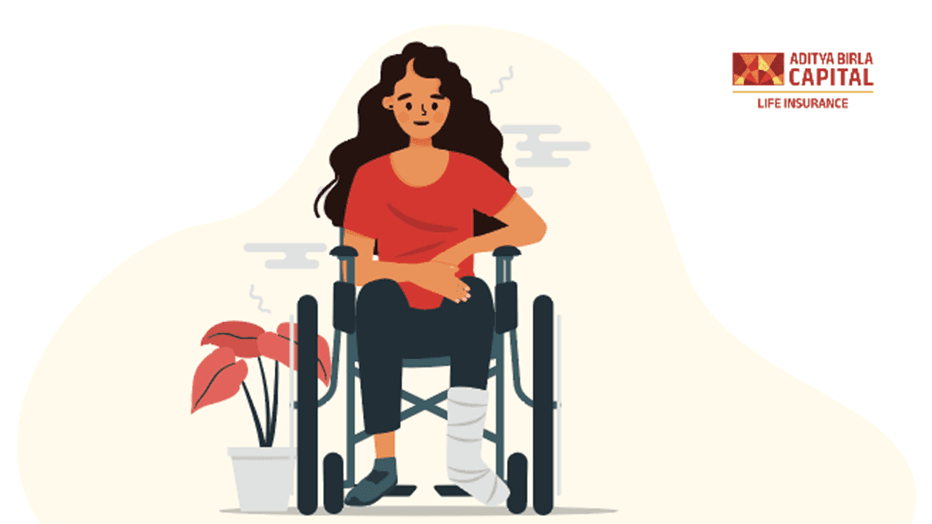
 Table of Contents


 BUY ONLINE