

- All Insurance
- Endowment Plans
- Savings PlansNew
- Term Insurance
- Pension PlansNew
- Critical Illness Insurance
- ULIP Plan
- Group Insurance
- Protection Solutions
- Employer Employee
- Voluntary
- Affinity
- Credit Life
- Retirement Solutions
- Annuity Scheme
- Gratuity
- Leave Encashment
- Post Retirement Medical Benefits Scheme
- Superannuation
- Withdrawn Products
- NRI Plans
- Articles
- Where Do I?
- Find Customer Service
- Learn About Life Insurance
- Become a Life Insurance Advisor
- Know Our Funds
- Manage My Claim
- Know more about UPI Autopay
- Read FAQs
- Register For One ABC Id
- Download Forms
- Read Market Outlook
- Download Public Disclosures
- Disclosure of Key Performance and Financial Parameters
- Financial Calculator
- Know your Advisor
- Term Insurance
- Manage My Policy
- Her Insurance

Connect
Aditya Birla Sun Life Insurance Company Limited



Aditya Birla Sun Life Insurance Company Limited
HomeArticlesTerm Insurance vs. Home Loan Protection Plan in 2026: Which cover is right for your family?
Term Insurance vs. Home Loan Protection Plan in 2026: Which cover is right for your family?
 August 27, 2026
 5 mins read


Plan Smarter, Live Better!

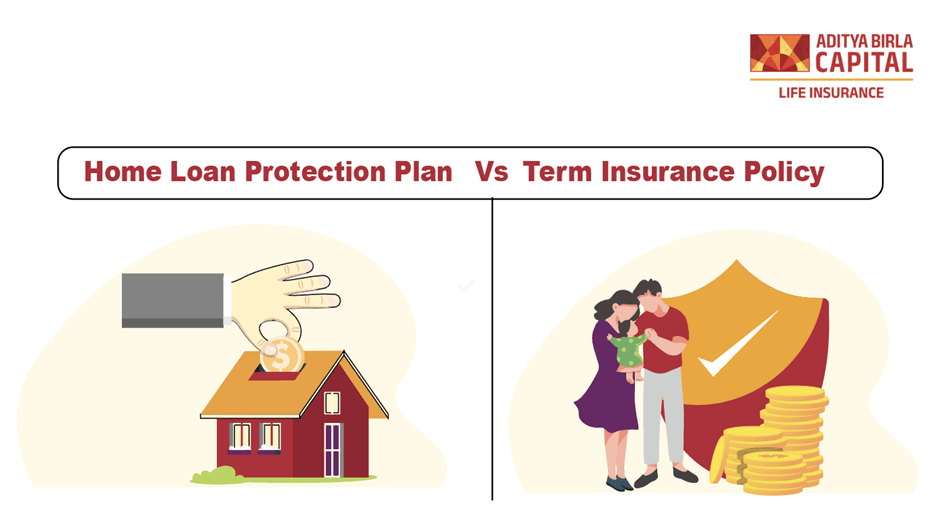
 Table of Content
How Much Helpful You Found This Article?

Rated by 0 reader
/ 5 ( reviews )
Not helpful
Somewhat helpfull
Helpful
Good
Best

Thank you for your feeback
Frequently asked questions
It depends on the financial objective. Term Insurance generally provides broader family protection because the death benefit can address the home loan and other household needs, while loan protection is focused on the insured debt. ABSLI reported a 98.86% individual claim settlement ratio for FY 2025-26 based on annual audited figures submitted to IRDAI. Buyers should compare cover, terms, exclusions, and affordability before deciding.
The required cover should include the Home Loan plus the amount needed for income replacement, household expenses, and future family goals, after considering existing assets and insurance. There is no single universal amount. A borrower should calculate the protection gap rather than simply matching the outstanding Loan. ABSLI’s Term Insurance calculator can be used to estimate cover and indicative premiums.
Compare the purpose, ownership, sum assured, policy duration, premium, payout structure and what happens to the cover as the loan reduces. Also consider whether the family needs protection beyond the home loan. A term plan can provide a broader death benefit, while loan protection is more directly linked to the debt. The best choice depends on the borrower’s overall financial protection requirement.
Accuracy note: FY2025-26 ended on 31 March 2026, so an IRDAI FY2025-26 Annual Report could not have been published in April 2025. This article therefore does not attribute the FY2025-26 ABSLI CSR to an April 2025 IRDAI report. It uses ABSLI’s current FY2025-26 disclosure, which states that 98.86% of individual claims were settled based on annual audited figures submitted to IRDAI. The article avoids presenting an unsupported universal benchmark for home-loan protection adequacy.
ABSLI - Current Term Insurance Plans
ABSLI - Term Insurance Calculator
ABSLI - Super Term Plan / Buy Now
ABSLI - FY2025-26 claims disclosure
ABSLI - Annual Report 2024-25
IRDAI - official regulatory website and circulars
Show All
Hide
Buy ₹1 Crore Term Insurance at Just ₹575/month*
ABSLI Super Term Plan
Term plan designed for salaried individual.

3 Plan Options

Health Management Service Worth ₹74000

100% return of premium
Life Cover
₹1 crore
Premium:
₹575/month*
 BUY ONLINE
Recently Added Article




Most Popular Calculator


This article is for general informational purposes only and does not constitute financial, tax, legal or insurance advice. Insurance products, premiums, eligibility, underwriting, benefits, tax treatment and claims are subject to applicable laws, regulations and specific policy terms. Readers should review the latest policy documents and consult the insurer or a qualified professional where appropriate. Claim settlement ratios are historical indicators and do not guarantee future claim outcomes.

