Life Insurance generally covers death from illness, natural causes, and accidents, subject to the policy terms. Accidental Death Insurance pays only when death meets the contract’s accident-related conditions. If your family depends on your income, accident-only protection leaves an important gap because illness-related death does not meet that benefit trigger.
What is the difference between Life Insurance and Accidental Death Insurance?
The main difference is the event that activates the benefit. A Life Policy provides the death benefit described in its contract during the covered period. Accident-only death protection has a narrower trigger: the death must result from a qualifying accident. Neither label removes exclusions, policy-status requirements, or the need to establish a valid claim.
For this comparison, Life Insurance means broad death protection, particularly term cover. It does not mean every Life Policy has identical benefits. Read the benefit wording rather than assuming a savings feature, maturity payment, or extra accident payout is included.
|
Point
|
Broad life death cover
|
Accident-only death cover
|
|
Illness-related death
|
May be covered under the policy
|
Does not meet the accident-only trigger
|
|
Accidental death
|
May be covered under the base benefit
|
Must meet the accident definition and conditions
|
|
Survival with disability
|
Only if specifically insured
|
Only if expressly included
|
|
Policy form
|
Base life policy
|
Standalone cover or optional rider, as applicable
|
|
Claim decision
|
Base policy conditions apply
|
Accident-specific conditions also apply
|
Comparison is generic, not a comparison of insurers. See [2–6].
Does Term Insurance already cover accidental death?
A Term Policy’s base death benefit can cover accidental death under its terms even without an accidental death rider. The rider is an optional additional benefit, rather than the feature that makes all accident deaths eligible under the base policy. Check the policy schedule for the benefit actually selected and the period of cover.
A base death claim and a rider claim require separate assessment. An accident rider may have a causation test, exclusions, or a time limit that the base death benefit does not share. If the rider’s condition is not met, that alone does not establish whether the base claim is payable.
Can the base policy and accident cover both pay?
Both benefits may be payable if the death independently satisfies the base policy and the additional accident benefit. The amount depends on the actual contracts and selected cover. Do not assume the payout doubles. The rider amount may differ from the base death benefit and combined-benefit limits may apply.
Illustrative example only: Assume a base death benefit of ₹50 lakh and a separate additional accidental death benefit of ₹10 lakh. If both claims qualify and no adjustment applies, the total is ₹60 lakh. For an illness-related death, the base benefit may be ₹50 lakh while the accident-only benefit is not payable. These amounts are hypothetical assumptions, not a premium quotation or product illustration.
Check whether a benefit is additional or accelerated. An accelerated benefit can reduce a later benefit. An additional benefit is assessed under its own terms. Keep these distinctions visible when reviewing a proposal.
What counts as an accidental death?
An everyday description of an accident is not enough to determine claim eligibility. Contracts can define accident, injury, and accidental death separately, require a direct link between injury and death, and set a maximum period between the accident and death. The cover must also satisfy the contract’s applicable policy-status conditions.
A road collision or fall may be a relevant scenario, but it is not an automatic promise of payment. Medical evidence and the circumstances must fit the issued wording. If illness contributes to an incident, ask how the causation clause applies rather than assuming that any death following an accident qualifies.
Which exclusions and policy conditions should you check?
Check the exclusions for each benefit separately. Accident wording may address intentional injury, alcohol or drug influence, hazardous activities, war, or other specified circumstances. A base policy’s suicide clause has its own wording and may specify a different payment from the usual death benefit. Avoid treating one exclusion list as universal.
Before buying, locate the policy’s accident definition, cover end date, premium provisions, and lapses or paid-up conditions. Ask for written clarification if the summary and the contract appear inconsistent. Do not rely on a headline that says all causes are covered or that premiums alone settle every eligibility question.
Does accidental death cover include disability or hospital bills?
Accidental death cover does not automatically pay when the insured survives with an injury. Disability benefits must be expressly included, with covered injuries and payout rules stated in the contract. A death benefit also should not be treated as reimbursement of hospital expenses. Check each benefit rather than inferring protection from the product’s name.
For a combined death-and-disability benefit, review the defined disability, evidence needed, assessment period, and benefit schedule. Also check whether an earlier disability payment reduces a later accident death payment. Temporary inability to work is not the same as the permanent disability defined by a contract.
How should you choose the cover and compare premiums?
Start by estimating what your household would need after your death, including living costs, liabilities, and future commitments, then account for existing dependable resources. Decide the broad life cover first. Consider accident-specific protection as an additional choice, and assess surviving an accident as a separate financial risk. This is a planning approach, not a universal purchase recommendation.
Compare written quotations with the same cover amount, term, and benefit scope. Review occupation and activity disclosures, renewal conditions, and exclusions alongside price. Do not replace broad life cover solely because an accident-only quotation appears cheaper. A smaller premium can reflect a different insured event rather than equivalent protection.
Answer application questions accurately and complete any underwriting requirements requested. Ask whether adding the benefit later is allowed and whether further assessment is needed. Do not assume all life applications require a medical test or that accident protection is issued without underwriting.
What should your family know about making a claim?
Keep policy records accessible and tell the nominee how to contact the insurer. A death claim generally requires the claim form, death certificate, claimant identification, and bank details. Accident-related claims may need further evidence, such as police or medical records, to establish the event and cause of death. Requirements depend on the claim.
Ask for the current document checklist and explain any record that cannot be obtained. Where more than one benefit is involved, identify each cover when notifying the insurer. If a benefit is declined, request the written reason and the relevant clause, then use the applicable grievance process.
How can ABSLI help you check an accident rider?
ABSLI provides rider information and policy documents that can help you identify the insured event and benefit conditions. The live page for ABSLI Accidental Death Benefit Rider Plus (UIN 109B023V02) describes an accident-linked death benefit. Its stated accident-to-death period is 180 days, with the rider required to be in force on the accident date, including the grace period.
This is an optional rider attached to an eligible Life Policy, not standalone life cover. Confirm its current classification, permitted base-plan combination, exclusions, and issued contract before choosing it. Do not assume it includes disability. The page published is a summary. This draft does not substitute an older specimen for the current rider contract.






 October 12, 2026
 5 mins




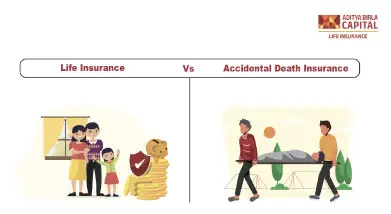
 Table of Contents


 BUY ONLINE