

- All Insurance
- Endowment Plans
- Savings PlansNew
- Term Insurance
- Pension PlansNew
- Critical Illness Insurance
- ULIP Plan
- Group Insurance
- Protection Solutions
- Employer Employee
- Voluntary
- Affinity
- Credit Life
- Retirement Solutions
- Annuity Scheme
- Gratuity
- Leave Encashment
- Post Retirement Medical Benefits Scheme
- Superannuation
- Withdrawn Products
- NRI Plans
- Articles
- Where Do I?
- Find Customer Service
- Learn About Life Insurance
- Become a Life Insurance Advisor
- Know Our Funds
- Manage My Claim
- Know more about UPI Autopay
- Read FAQs
- Register For One ABC Id
- Download Forms
- Read Market Outlook
- Download Public Disclosures
- Disclosure of Key Performance and Financial Parameters
- Financial Calculator
- Know your Advisor
- Term Insurance
- Manage My Policy
- Her Insurance

Connect
Aditya Birla Sun Life Insurance Company Limited



Aditya Birla Sun Life Insurance Company Limited
What is Indirect Tax? Understand the Types, Features, and Filing Here
 February 18, 2025
 5 mins read


Plan Smarter, Live Better!

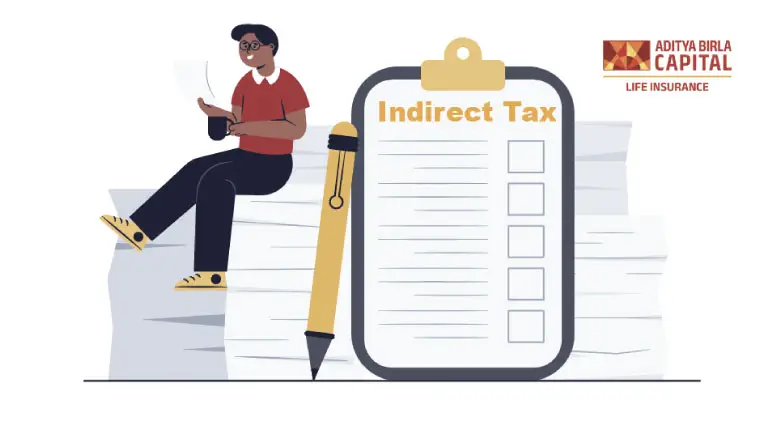
 Table of Contents
How Much Helpful You Found This Article?

Rated by 0 reader
/ 5 ( reviews )
Not helpful
Somewhat helpfull
Helpful
Good
Best

Thank you for your feeback
FAQs - What is Indirect Tax
An indirect tax is a tax collected by businesses from consumers on goods and services. Unlike direct taxes, where the tax burden falls on the person liable to pay, the burden of indirect tax is passed on to the final consumer.
The key features of indirect tax include the shifting of the tax burden to consumers, varied rates for different products, the ability to regulate consumption, difficulty in avoidance, and revenue generation for the government.
The main types of indirect taxes in India include Goods and Services Tax (GST), Customs Duty, and Excise Duty. GST has further categories like Central GST (CGST), State GST (SGST), and Integrated GST (IGST).
GST has subsumed several previous indirect taxes, such as Value Added Tax (VAT), Service Tax, and Excise Duty on many products. However, Customs Duty and Excise Duty on specific items like liquor still exist.
Businesses with a turnover exceeding ₹20 lakhs (₹10 lakhs for Northeastern states) in a financial year must register for GST. Other criteria may also require registration.
Direct taxes are paid directly by the person on whom they are levied, such as income tax. Indirect taxes, on the other hand, are levied on goods and services, and the burden is passed on to the final consumer.
Yes, by setting higher tax rates on harmful or luxury items, the government can discourage consumption. Lower taxes on essential items can make them more accessible.
GST returns can be filed online through the GST portal. The frequency and type of return depend on the turnover and registration type of the business.
Customs Duty is a tax levied on imports and exports. It protects domestic industries from foreign competition and regulates international trade.
Some argue that indirect taxes are regressive as they apply uniformly, regardless of income level. This means that lower-income individuals may bear a proportionally higher burden. However, the government often tries to balance this by setting lower rates on essential goods.
Show All
Hide
Buy ₹1 Crore Term Insurance at Just ₹575/month1
ABSLI DigiShield Plan
Life cover up to 100 years of age.

Joint Cover Option

Inbuilt Terminal Illness Benefit

Tax Benefit^

Return of Premium Option~
Life Cover
₹1 crore
Premium:
₹575/month1
 BUY ONLINE
Recently Added Article


Most Popular Calculator


ADV/2/24-25/2896

