A Term Plan gives your family a lump sum that can replace years of your income, cover outstanding Loans, and fund ongoing expenses such as education, without you having to save that amount separately first. Because there is no investment component, premiums for the same cover are typically far lower than for Savings Life Insurance products. This makes it possible for a young earner to hold a meaningfully large cover, such as Rs. 1 crore or more, from early in their career, when premiums are lowest relative to age.
How do you choose the right Term Insurance Plan?
Choosing the right Term Insurance comes down to five checks:
- How much cover do you actually need
- How long should the policy run
- What premium structure suits your cash flow
- Which riders close real gaps
- How consistently the insurer has settled claims
Each of these is covered in this article, in roughly the order most buyers work through them, from sizing the cover to checking what a plan excludes to how it is taxed. Getting these right matters more than chasing the lowest premium.
How much Term Insurance cover do you actually need?
A commonly used starting benchmark is 10 to 15 times* your annual income, adjusted upward for outstanding loans and your dependents' future costs, and downward if you already hold other cover. For example, a salaried professional earning Rs. 12 lakh a year would, on this benchmark, look at a cover between roughly Rs. 1.2 crore and Rs. 1.8 crore (illustrative calculation, not a quote). This calculator-based cover estimate can help refine the number against your actual Loans, dependents and goals rather than a flat multiple.
The most common mistake we see is buyers anchoring on a round figure, such as flat Rs. 1 crore, because it is a familiar number, rather than working backwards from their family's real future expenses and liabilities.
*Source: Explained: Why your ideal term cover should be 10-15 times your annual pay | Personal Finance - Bus…
How long should the policy term run?
The term should generally cover the years your family would be most financially exposed, typically until you retire or your children become financially independent, whichever is later. A term ending too early can leave your family without protection during years when obligations, such as a Home Loan or a child's education, are still active. A term running well past your working years, on the other hand, may mean paying for cover you no longer need.
Read more
What premium payment options are available?
Term Plans are typically available in three premium payment options:
- Regular pay: Premium spread across the full policy term
- Limited pay: Premium paid in a shorter number of years e.g. 5 years, 10 years etc.
- Single pay: Full premium paid upfront
A single premium policy suits someone who prefers to close out the payment obligation in one go, while limited pay can help align the paying period with your expected active working years. The right structure depends on your cash flow rather than on the cover amount itself.
Which riders are worth adding?
Riders such as critical illness, accidental death benefit, disability, and waiver of premium extend a Term Plan beyond the base death benefit, and interest in add-on protection like this has grown as buyers look for broader cover in one policy. A critical illness rider pays out on diagnosis of a covered illness, independent of the death benefit. An accidental death benefit rider adds to the payout if death is due to an accident.
A waiver of premium rider keeps the policy active without further premiums if you are unable to pay due to disability or critical illness. Riders are optional and add to the premium, so it is worth checking whether each one addresses the gap that your base cover does not.
Why does the claim settlement ratio matter?
The claim settlement ratio shows the proportion of claims an insurer has paid out in a year, and it is one of the few objectives, regulator-published indicators of how consistently an insurer honors claims. IRDAI publishes claim settlement data annually as part of its Annual Report. It is worth checking last three years’ published claim settlement ratio to check if it’s consistently above 97%. Read them alongside claim turnaround time and the insurer's disclosures, rather than in isolation.
Our (ABSLI) individual or retail claim settlement ratio for the last three financial years, as per annual audited figures submitted to IRDAI are:
- FY 2025–26: 98.86%
- FY 2024–25: 98.74%
- FY 2023–24: 98.49%
What do Term Plans typically exclude?
Most Term Plans exclude death by suicide within the first 12 months of the policy and can reject a claim if material facts about health, income, or lifestyle were not disclosed at the time of purchase. Some exclusions are specific to riders rather than the base plan, such as pre-existing conditions’ waiting periods on a critical illness rider. Reading the policy wording and the sales brochure before buying, rather than relying only on a summary, is the only way to know the exact exclusions that apply.
Is employer-provided life cover enough?
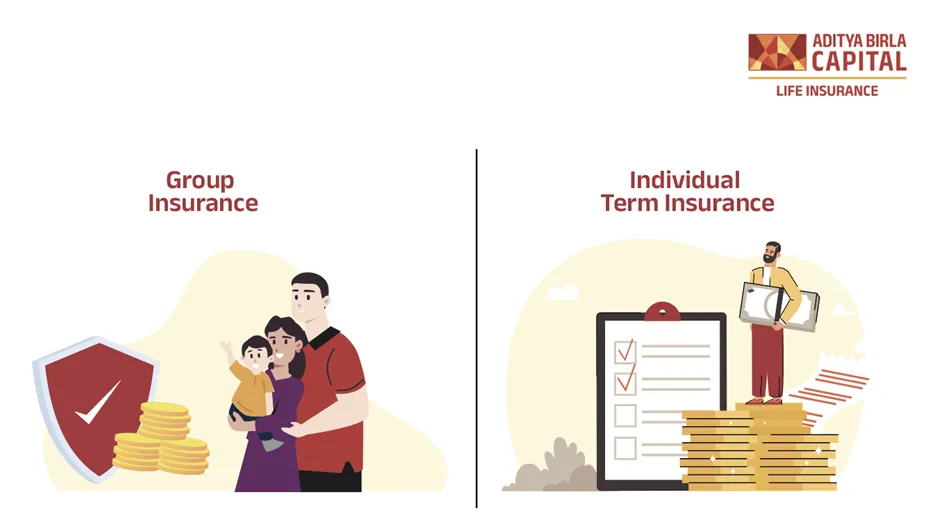
Usually not on its own. Employer-provided group cover is typically limited to multiple salary and stops the day you leave the job, so it does not travel with you or scale to your family's full requirement. An independent Term Plan continues regardless of your employer, can be sized to your actual need rather than a standard group multiple, and locks in a premium based on your age at purchase. Group cover works well as a supplement to an individual plan, not a replacement for one.
How do Term Insurance premiums affect your taxes?
Term Insurance premiums can qualify for a deduction of up to Rs. 1,50,000 a year under Section 123 of the Income Tax Act 2025 (previously Section 80C), under the old tax regime. The death benefit paid to your nominee is generally tax-free under Section 11 read with Schedule II of the Income Tax Act 2025 (previously Section 10(10D)), subject to conditions.
Both provisions depend on the tax regime and conditions in force at the time, so it is worth confirming current applicability with a summary of Section 80C and a tax advisor before assuming a deduction applies to your situation.
How does ABSLI help?
ABSLI offers a range of Term Insurance Plans designed to provide comprehensive life cover at affordable premiums, helping you choose protection based on your income, financial responsibilities and life stage.
For comprehensive cover: ABSLI Super Term Plan is designed to provide substantial life cover at an affordable premium, helping you create a financial safety net for your loved ones in your absence.
For salaried individuals: ABSLI Salaried Term Planhttps://lifeinsurance.adityabirlacapital.com/term-insurance/absli-salaried-term-plan/ is designed around the protection needs of working professionals, offering life cover that can help safeguard their family's financial goals and ongoing expenses.






 August 31, 2026
 5 mins read





 Table of Contents


 BUY ONLINE