Aditya Birla Sun Life Insurance Company Limited

Understanding Risk and Returns in Investments

Icon_Calender December 31, 2025
Icon-Clock5 mins read
Rated by reader
https://lifeinsurance.adityabirlacapital.comnullCLOSE-BUTTON

Plan Smarter, Live Better!

*Min 3 characters allowed
+91
*Please enter a valid 10 digit Mobile No
https://lifeinsurance.adityabirlacapital.comnullCLOSE-BUTTON
ICON-TICK

Thank you for your details. We will reach out to you shortly.

https://lifeinsurance.adityabirlacapital.comnullCLOSE-BUTTON
ICON-TICK

Currently we are facing some issue. Please try after sometime.

banner-imagemob-image
  • Icon-Index
    Table of Contents

If you have a chronic health issue like diabetes, hypertension, or a history of cardiovascular disease, you might worry that securing a comprehensive term insurance policy is impossible. This is a common concern for individuals with pre-existing medical conditions (PEDs), but it's important to know that it is absolutely possible to get coverage.

The process is simply more detailed, as the insurance company needs to accurately assess the risk. Transparency and diligence are your biggest allies. This guide from ABSLI explains the current regulatory landscape and the essential steps you must take to get the term insurance you need, even with a PED.

The Golden Rule: Why 100% Honesty is Mandatory

The single most important factor in securing term insurance for pre existing medical conditions is complete and truthful disclosure of your health history.

You must disclose all pre-existing medical conditions because hiding them constitutes non-disclosure, which gives the insurer the legal right to reject the claim and void the policy later. (1).

  • Underwriting Assessment: Insurance is based on shared risk. The underwriter uses information about your health to determine your personal risk profile. This process helps the insurer decide whether to accept the application, decline it, or accept it with special terms.
  • Consequence of Non-Disclosure: If your nominee files a claim and the insurer discovers a relevant, undeclared PED, the claim can be rejected based on misrepresentation of facts, nullifying the years of premium payments. This is the biggest financial risk to your family.
  • The Moratorium Period: While IRDAI has set strict guidelines for health insurance claims, for life insurance, honesty at the outset is the only guarantee against future claim disputes (2).

The Mandatory Step: Medical Check Up for Term Insurance

For anyone with a pre-existing condition or seeking a high Sum Assured, the medical check up for term insurance is a compulsory step that ultimately protects the nominee. A medical check up for term insurance is required for applicants with PEDs to allow the insurer to gauge the severity of the condition and set a fair premium; skipping the check up often results in lower, insufficient coverage or policy rejection.

What the Medical Check-up Reveals

The tests confirm the information provided in your application and determine if your condition is managed.

  • For Diabetics (The HbA1c Test): For individuals with diabetes or pre-diabetes, the HbA1c test is crucial. Insurers generally approve coverage if your blood sugar levels have been well-controlled for the last 6 to 12 months (3). Applicants relying on diet/oral medication are often viewed more favourably than those requiring frequent insulin injections.
  • Common Tests: Beyond condition-specific tests, the general medical evaluation includes checks for blood pressure, cholesterol, BMI, and basic blood and urine samples.
  • High Sum Assured: Even healthy applicants are required to undergo a medical test if they apply for a large Sum Assured (often above ₹1 Crore) because the financial risk to the insurer is higher.

Outcomes: How a PED Impacts Your Policy Terms

Having a pre-existing medical condition does not lead to an automatic rejection. Instead, it leads to one of four predictable outcomes in the underwriting process. If you have a PED, your policy may be accepted with a premium loading (higher cost), specific exclusions, or through a specially designed plan for your condition.

  1. Acceptance with Premium Loading This is the most common outcome. The insurer accepts the risk but charges an additional fee (loading) on your standard premium to cover the higher statistical risk of an early claim.
  • Fair Pricing: This loading ensures that the policy remains financially viable for the insurer while providing you with full coverage for your family.
  • Control Factors: The loading amount depends on your age at diagnosis (later diagnosis often results in lower loading) and how well you control the condition.

  1. Acceptance with Specific Exclusion In some cases, the insurer may accept the application but place an exclusion clause stating that death resulting directly from the diagnosed PED will not be covered. However, death from any other cause (e.g., accident, natural death unrelated to the PED) remains fully covered.

  2. Acceptance with Reduced Sum Assured For very high-risk PEDs, the insurer may reduce the maximum Sum Assured they are willing to offer to mitigate their exposure.

  3. Specialized Plans Insurers like ABSLI offer plans specifically designed for common PEDs like diabetes and hypertension, providing tailored coverage where the underwriting is focused entirely on managing that specific chronic condition.

Term Insurance Without Medical Check Up: The Risk

While some insurers offer term insurance without medical check up for young, low-Sum Assured applicants, this option is strongly discouraged for anyone with a known health condition.

Seeking term insurance without medical check up is risky for individuals with PEDs because the policy relies solely on your self-declaration; if the insurer discovers a non-disclosed PED during a claim investigation, the claim is highly likely to be rejected.

  • The Claim Conundrum: When a claim is filed, the insurer investigates the medical history. If the death is even remotely linked to the undisclosed PED, the policy can be rejected, leaving your nominee with nothing.
  • Coverage Limits: These policies often have severe restrictions on the maximum Sum Assured (e.g., capped at ₹50 Lakh to ₹1 Crore), which may be insufficient for a family's financial needs.

Conclusion

A pre-existing condition is a hurdle, not a roadblock, to obtaining financial security. By providing complete transparency, diligently managing your health, and agreeing to the necessary medical check up for term insurance, you maximize your chances of policy approval and, most importantly, guarantee a smooth, hassle-free claim settlement for your family when they need it most.

How Much Helpful You Found This Article?

Rating_Star
Rated by 0 reader
/ 5 ( 0 reviews )
Not helpful
Somewhat helpfull
Helpful
Good
Best
RatingTick

Thank you for your feeback

Don’t forgot to share helpful information in your circle

FAQs

Investment risk is the possibility that the actual returns on an investment will be different from the expected returns. It involves the uncertainty of future investment performance.

Assess your financial situation, investment goals, time horizon, and emotional capacity to handle market fluctuations. You can also use risk tolerance questionnaires provided by financial institutions.

Generally, higher potential returns come with higher risk, and lower risk typically results in lower returns. Investors must balance their desire for high returns with their willingness to accept risk.

Common types of investment risk include market risk, credit risk, inflation risk, interest rate risk, and liquidity risk.

Manage investment risk by diversifying your portfolio, using proper asset allocation, regularly rebalancing your investments, and staying informed about market conditions and trends.

Diversification involves spreading your investments across different asset classes and sectors to reduce risk. It helps ensure that poor performance in one area does not significantly impact your overall portfolio.

Asset allocation is the process of dividing your investment portfolio among different asset categories, such as equities, bonds, and real estate, based on your risk tolerance and investment goals.

It is advisable to review and rebalance your portfolio at least once a year or whenever there are significant changes in your financial situation or market conditions to maintain your desired asset allocation.

Returns refer to the profit or income generated by an investment over a certain period. They can come in the form of capital gains, dividends, or interest income.

Maximise returns while managing risk by starting early, being consistent with your investments, reinvesting returns, diversifying your portfolio, using low-cost investment options, leveraging tax benefits*, and staying informed about your investments.

Show All
Hide

Thanks for reaching out. We will reach out to you shortly.

Thanks for reaching out. Currently we are facing some issue.

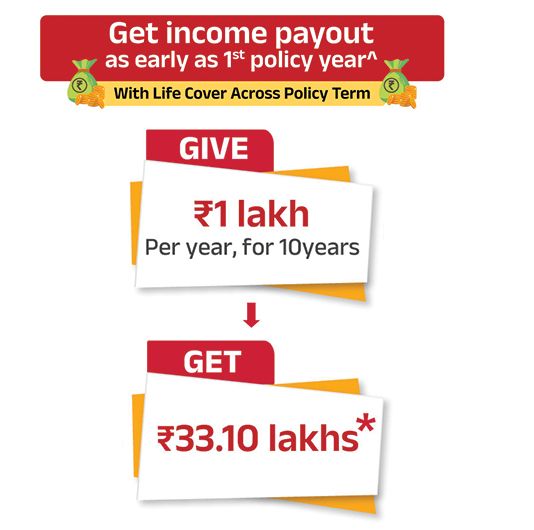
Get immediate income payout after 1 day of policy issuance^

*Min 3 characters
+91phone-icon
*Please enter a valid 10 digit Mobile No.
*This field is required.

ABSLI Nishchit Aayush Plan

ICON-CLICK

Guaranteed# Income

ICON-CLICK

Life Cover across policy term

ICON-CLICK

Lumpsum Benefit at policy maturity.

Get:
₹33.74 lakhs~

Pay:
₹10K/month for 10 years

*Tax benefits are subject to changes in tax laws. Kindly consult your financial advisor for more details

Please note that we have provided our above views based on current interpretation of income tax provisions.

Such interpretations may differ at customer’s consultant level. ABSLI shall not be responsible for tax positions adopted by customer.

ADV/12/25-26/1472

whatsapp-imagewhatsapp-image