Aditya Birla Sun Life Insurance Company Limited

How does the power of compounding work?

Icon-Calender September 2, 2026
Icon-Clock5 min read
★
4.5
Rated by 1000 readers
https://lifeinsurance.adityabirlacapital.comnullCLOSE-BUTTON

Plan Smarter, Live Better!

*Min 3 characters allowed
+91
*Please enter a valid 10 digit Mobile No
https://lifeinsurance.adityabirlacapital.comnullCLOSE-BUTTON
ICON-TICK

Thank you for your details. We will reach out to you shortly.

https://lifeinsurance.adityabirlacapital.comnullCLOSE-BUTTON
ICON-TICK

Currently we are facing some issue. Please try after sometime.

banner-imagemob-image
  • Icon-Index
    Table of Contents

The power of compounding means that earnings added to your money can earn further returns themselves. Given enough time, this can make growth accelerate. The outcome is not automatic, however. It depends on the return actually earned, how often earnings are credited and reinvested, fees, taxes, withdrawals, inflation, and the risk of the chosen product.

What does compounding mean?

Compounding is the process of calculating future earnings on both the original amount and previously accumulated earnings. With simple interest, earnings are calculated only on the original principal. With compounding, the base can grow after each crediting period, so the next period's earnings may be calculated on a larger amount.

For example, if ₹1,00,000 earns an illustrative 8% annually and the full earning is reinvested, it becomes ₹1,08,000 after one year. In the next year, the illustrative 8% applies to ₹1,08,000, not only to the initial ₹1,00,000. The second year's earning is therefore ₹8,640, taking the balance to ₹1,16,640.

What is the compound interest formula?

For a single lumpsum, the standard formula is A = P(1 + r/n)^(nt). Here, A is the future amount, P is the principal, r is the annual rate expressed as a decimal, n is the number of compounding periods per year, and t is time in years. Compound interest equals A minus P. If interest is compounded once a year, n equals 1. If earnings are credited more frequently, n changes. A reader should use the frequency stated in the relevant product terms instead of assuming monthly, quarterly, or annual compounding.  

What does compounding look like over time?

A transparent illustration makes the effect easier to see. Assume a one-time amount of ₹1,00,000, an illustrative annual return of 8%, annual compounding, no additional contributions, and no fees, taxes or withdrawals. These assumptions are simplified and do not represent a promise, forecast, or benefit illustration for any product.

End of year

Illustrative amount

Growth over original amount

1

₹1,08,000

₹8,000

5

₹1,46,933

₹46,933

10

₹2,15,892

₹1,15,892

20

₹4,66,096

₹3,66,096


The table shows why time matters. Later growth is calculated on the enlarged base. It does not show purchasing power. If prices rise over the same period, the future amount may buy less than its face value suggests. Inflation therefore belongs in any long-term goal estimate.

Why does starting early make a difference?

Starting earlier gives earnings more periods in which to earn additional returns. Using the same simplified assumptions, ₹1,00,000 compounded annually at an illustrative 8% grows to about ₹2.16 lakh after 10 years and ₹4.66 lakh after 20 years. Doubling the time horizon more than double the illustrated ending amount because growth is applied to accumulated earnings as well as principal.

Time cannot turn an unsuitable product into a suitable one or eliminate market, credit, liquidity, or inflation risk. It simply gives the compounding mechanism more periods to operate. A sensible decision starts with the goal, time horizon, liquidity needs and risk capacity.

Do regular contributions compound in the same way?

Regular contributions can build a larger corpus, but two forces are working together: new money is being added and each contribution has its own time to compound. A contribution made early has more potential compounding periods than one made near the end. This is why a recurring contribution result should not be compared directly with a single lumpsum result.

The exact formula also depends on whether each contribution is made at the beginning or end of a period. When using a calculator, check the contribution timing, compounding frequency, assumed rate, charges, and whether the result is before or after tax.

Does a higher compounding frequency always produce more money?

With the same stated nominal annual rate and no other differences, more frequent crediting can produce a slightly higher mathematical result because earnings are added to the base sooner. In practice, products may quote rates differently and may apply charges, lock-ins, benefit conditions, or market-linked returns. Frequency should never be judged in isolation.

How can you use compounding responsibly for financial goals?

Use compounding as a planning concept, not as a guarantee. A practical process is to define the goal and date, estimate the future cost after inflation, decide what contribution is affordable, test more than one return assumption, and review progress periodically. Keep a separate emergency reserve so an unexpected expense is less likely to interrupt a long-term plan.

  • Read the official product document and benefit illustration before committing money.
  • Distinguish guaranteed benefits, if any, from non-guaranteed or market-linked outcomes.
  • Check charges, surrender or withdrawal rules, exclusions, tax treatment, and liquidity.
  • Do not select a Life Insurance Policy only because an illustration shows a large maturity value. Assess the life cover and whether the policy fits the protection need.

How can ABSLI help?

Aditya Birla Sun Life Insurance Company Limited offers Life Insurance information and product documents through its official website. If you are considering a Savings Plan, review the applicable sales brochure, policy wording, and personalised benefit illustration. Ask which benefits are guaranteed, which are non-guaranteed, what charges or conditions apply, and whether the life cover is appropriate for your needs.

What should you remember about compounding?

Compounding can support long-term goal planning because reinvested earnings may generate further earnings. Its effect becomes more visible with time, but the final outcome depends on real-world returns and product conditions. Use conservative assumptions, account for inflation and costs, preserve liquidity, and verify every promise against the official document before deciding.

How Much Helpful You Found This Article?

Rating_Star
Rated by 0 reader
/ 5 ( 0 reviews )
Not helpful
Somewhat helpfull
Helpful
Good
Best
RatingTick

Thank you for your feeback

Don’t forgot to share helpful information in your circle

Frequently asked questions

No. Compounding describes how returns accumulate. It does not determine whether a return will be earned. Risk depends on the underlying product and its terms. Even a fixed or guaranteed benefit may be subject to eligibility and premium-payment conditions. Read the official documents and do not treat an illustration as an assured outcome.

The Rule of 72 is a rough mental estimate of the time an amount may take to double: divide 72 by an assumed annual percentage rate. At 8%, the estimate is about 9 years. It is only an approximation and does not account for fees, taxes, irregular returns, or product conditions.

If earnings are withdrawn instead of being added to the base, they cannot generate further earnings within that arrangement. Withdrawals can therefore reduce the future amount. They may also attract charges, tax consequences, or policy impacts, depending on the product and its terms.

Some Life Insurance Savings Plans may accumulate values or provide benefits over time, but their design is product specific. Do not assume that every policy credits compound interest at a stated rate. Check the sales brochure, policy wording, and personalised benefit illustration to understand guaranteed and non-guaranteed benefits.

A yearly review, and an additional review after a major life change, can help you compare progress with the goal. A review does not mean reacting to every short-term movement. Check affordability, protection needs, time horizon, assumptions, liquidity, and whether the product still serves its intended purpose.

Show All
Hide

Thanks for reaching out. We will reach out to you shortly.

Thanks for reaching out. Currently we are facing some issue.

Get immediate income payout after 1 day of policy issuance^

*Min 3 characters
+91phone-icon
*Please enter a valid 10 digit Mobile No.
*This field is required.

ABSLI Nishchit Aayush Plan

ICON-CLICK

Guaranteed# income

ICON-CLICK

Life Cover across policy term

ICON-CLICK

Lumpsum Benefit at policy maturity, in addition to Income

Get :
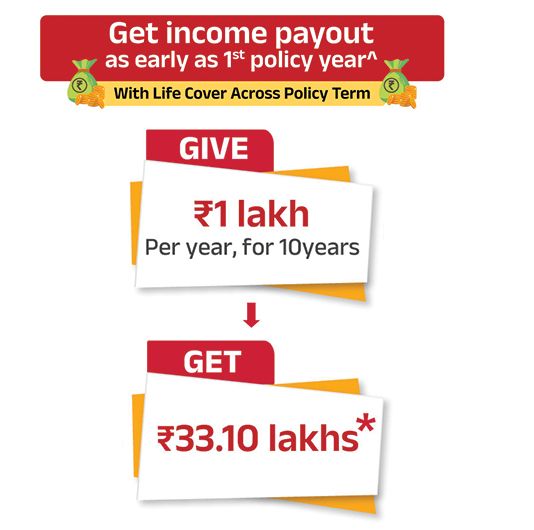
₹33.74 lakhs~

Pay: ₹10K/month for 10 years

This article is for general educational purposes and does not constitute investment, insurance, legal or tax advice. All calculations are illustrative and rounded. Actual outcomes depend on the chosen product, returns, charges, taxes, withdrawals and other terms. Past performance, where referenced, is not indicative of future performance. Please assess your needs and read the applicable sales prospectus, benefit illustration and policy document carefully before concluding a sale.

whatsapp-imagewhatsapp-image